The Short Answer
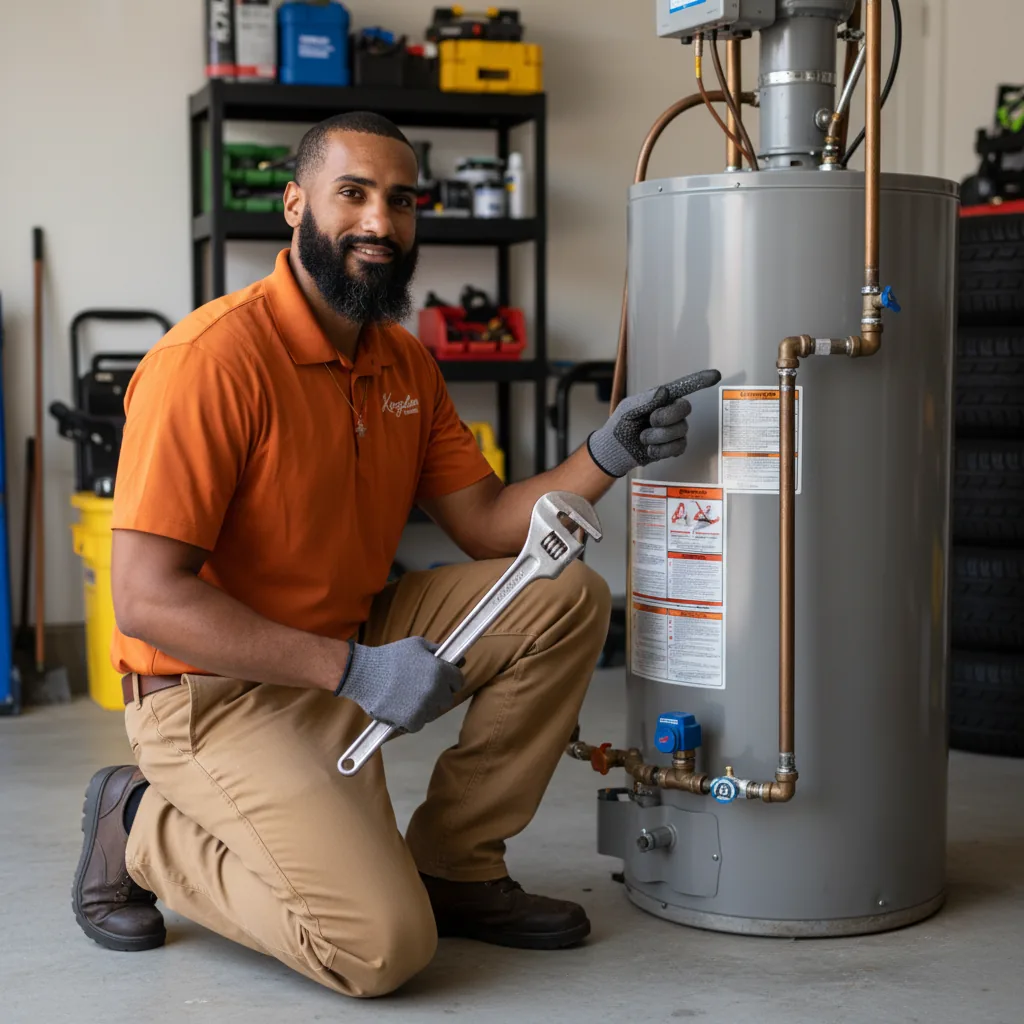
A standard 40 or 50 gallon tank water heater replacement in Las Vegas runs $3,100 to $3,600 installed. Larger tanks run $2,800 to $8,700. A tankless unit runs $7,900 to $9,900, and lands at the top of that range when the gas line or the venting has to be upgraded to support it. These are planning ranges from our own flat-rate price book, not quotes. Your number depends on what we find at your home, and you approve a flat rate before any work starts. Tank size, fuel type, where the unit sits, and the condition of the connections when it comes out are what move your number inside the range.
Nobody budgets for a water heater. It is the appliance that works silently in the garage for a decade and then fails on a Saturday, usually with a puddle. So the useful question is not what one costs in the abstract, but which of the two realistic numbers is yours, and what would push it higher. This guide lays out the local ranges, the things that move them, and the part of the decision that is specific to Las Vegas: our water. When you want a firm number, we give you a flat rate you approve before anything is disconnected.
Water Heater Replacement Cost in Las Vegas at a Glance
| Job | Typical Las Vegas range | What moves it |
|---|---|---|
| Tank replacement, 40 or 50 gallon | $3,100 - $3,600 installed | The standard residential job: gas or electric, old unit hauled away |
| Tank replacement, larger sizes | $2,800 - $8,700 installed | Tank size in gallons, up to a 100 gallon gas unit, and commercial-duty construction |
| Power vent, direct vent or high recovery | $5,300 - $8,700 installed | Needed where atmospheric venting is not allowed, or where the household needs faster recovery |
| Tankless installation | $7,900 - $9,900 installed | Whether the gas line has to be upsized, whether new venting is required, and the capacity you need |
| Tankless, you supply the unit | $5,600 - $6,300 | Labor, venting, gas and water connections only, for a unit you already bought |
| Water heater repair | $250 - $1,100 | Which part failed: thermocouple, element, thermostat, T and P valve, or gas control valve |
| Flush or descale | $140 - $325 | Tank flush, tankless descale, or anode rod replacement. The maintenance that buys years here |
| Thermal expansion tank | $350 - $400 | Required by UPC 608.3 on a closed system. Common here, and a line item an underpriced quote leaves out |
| Permit | $600 - $700 | Where the jurisdiction requires one. Part of the job, not added afterward |
These are the same published ranges we give in our Las Vegas plumbing cost guide, repeated here because this is the page people land on once the heater has already failed. If you are still deciding whether to repair or replace at all, repair versus replacement walks through the age, leak, and rust signals that settle it.
Tank or Tankless: Which Costs More, and Which Costs More Over Time
The upfront gap is the obvious difference. A tank unit is a simpler install, and much of the cost is the unit itself plus labor to disconnect, drain, and set the new one. A tankless install can double that, because the unit costs more and because the work around it often costs more than the unit. A tankless heater needs a gas line sized for its input and venting that meets the manufacturer requirements, and in a house built for a tank, neither of those is a given.
Comparing only the installed price is how people end up disappointed, though. A tankless unit heats water on demand and does not hold a standing tank of hot water, so it avoids the standby loss a tank has. Whether that saves you money depends on how your household uses hot water and on gas prices. Our tank versus tankless comparison works through the operating side properly rather than repeating a payback claim.
The honest local angle is repair risk. A tankless unit has more components that can fail and they cost more to replace, but it does not rot from the inside the way a tank does in hard water. A tank here tends to fail by leaking, and a leaking tank is not a repair. If your water is unsoftened and hard, that shortens the clock on a tank more than on a tankless, which is part of why the treatment conversation keeps coming up.
Why Water Heaters Wear Out Faster in Las Vegas
This is the part that matters more here than almost anywhere else. Las Vegas water is hard. The Las Vegas Valley Water District reports hardness in this valley around 16 grains per gallon, roughly 280 parts per million, and hard water leaves mineral sediment behind every time it is heated. In a tank, that sediment settles to the bottom, where the burner or the lower element has to heat through it. The unit works harder for the same hot water, and the tank floor is the first place to rust through.
The practical effect is a service life well short of the label. National guidance puts a standard tank at 8 to 12 years. In the Las Vegas valley Kingdom commonly sees closer to 5 years, because our hard water scales the tank and the heating surface, and because a water softener, while it protects the rest of the house, adds its own strain on the system. Both numbers are worth knowing: the 8 to 12 year figure is what the manufacturer literature and most national cost guides will tell you, and about 5 years is what we actually pull out of garages here. A tank that fails at year 6 in this valley is not unlucky. It is typical.
There are two ways to slow that down, and both are cheaper than a replacement. Flushing the tank annually removes the sediment before it hardens into a layer, and it is the single most skipped maintenance item on a water heater. How often to flush a water heater covers the interval and what the process actually involves. The other is treating the water, since the sediment is a function of hardness. Water softeners and softener versus filter explain which device does which job, because they are not interchangeable.
The Efficiency Rules, and What Is Actually True About 2026 Prices
There is a lot of confusion on this point, including in some of the quotes homeowners get, so it is worth stating plainly. The Department of Energy finalized new residential water heater efficiency standards in 2024, but compliance is not required until May 6, 2029, and it applies to units manufactured on or after that date. It is not a 2026 rule, and it is not the reason a quote looks higher this year.
When those standards do take effect, the biggest change is that electric storage tanks above 35 gallons will need heat pump technology to comply, while gas tankless models were carved out of that rule and left for a later rulemaking. That is a real shift worth knowing about if you are planning a replacement a few years out, particularly if you have an electric tank in a garage. It is not a reason to replace a working heater today.
What does move a quote in 2026 is ordinary: equipment costs from manufacturers, the condition of what is already in the house, and code items that have to be corrected while the unit is out. If a quote you received blames a 2026 federal efficiency mandate for the price, that explanation is not accurate, and it is fair to ask for the actual breakdown.
What Pushes a Quote Toward the Top of the Range
- Capacity. A larger household or a bigger tank costs more than a small one, and so does stepping up capacity because the old unit was undersized for the house.
- Fuel type and the gas line. Electric is usually the simpler swap. If you are moving to gas, or to a tankless unit with a higher input, the gas line may need to be upsized, and that is real work.
- Venting. A tankless unit needs venting that meets its manufacturer requirements. A house built for a tank may need new venting, and sometimes a new penetration in the roof or wall.
- Location and access. A unit in a tight garage corner, an attic, or a closet is harder to get out and get a new one into than one with clear space around it.
- Code items found on removal. The drain pan, the shutoff, the temperature and pressure relief valve discharge, and the vent connector all have to be right. A permitted job may require corrections that were not visible until the old unit came out.
- Permits and disposal. Hauling the old unit away is part of the job, and a permit where the jurisdiction requires one is part of the cost.
If a Quote Comes In Far Below These Ranges, Ask What Is Missing
A quote well under $3,100 to $3,600 for a standard tank swap is not usually a better deal. It is usually a different job. The ranges above are complete installs, and the things that get left out of a cheap number are the things that matter later.
- The thermal expansion tank. UPC 608.3 requires one on a closed system, and a service with a check valve or a pressure reducing valve on it is a closed system. That is $350 to $400 of real work. Without it, pressure spikes every time the heater fires, which is hard on the new tank and on every fixture in the house.
- The permit. Where the jurisdiction requires one it is $600 to $700, and it brings an inspection with it. A quote that omits the permit is not cheaper, it is incomplete, and it leaves an unpermitted gas or water heater appliance on your property for the next buyer's inspector to find.
- The code corrections found on removal. The drain pan, the shutoff, the T and P discharge routing and the vent connector all have to be right. A quote written over the phone cannot have accounted for them, so they arrive later as a change order.
- Hauling the old unit away, and the new water and gas flex connections rather than reusing the old ones.
None of that is a reason to accept the first number you are given. It is a reason to compare quotes on the same scope. Ask each company whether the expansion tank, the permit and the connections are included, and the three quotes in front of you usually stop looking so different.
Signs You Are Pricing a Replacement, Not a Repair
A failed thermocouple, a burned-out element, or a stuck valve is a repair, and those sit in the $250 to $1,100 range. A leaking tank is not. Once the tank itself is weeping, no repair makes it hold water again, and patching it is money spent on a unit that is already finished. A leaking water heater covers what to shut off first and how to tell a tank leak from a fitting leak.
The other signals are age against that roughly 5 year local expectation rather than the 8 to 12 years quoted nationally, rusty or metallic hot water, and a unit that has needed more than one repair in a couple of years. Noise is a subtler one. Popping and rumbling is usually sediment, and it means the tank has been working through a mineral layer for a while. That is the point at which flushing becomes damage control rather than prevention.
What to Have Ready Before You Get a Quote
A few details turn a vague range into a real number quickly. Note the age of the unit off its data plate, whether it is gas or electric, and its tank size in gallons. Take a photo of the unit and of the space around it, including the venting and the pan. If you have the original install paperwork or a home inspection report from when you bought the house, that helps pin down the model and the age.
It also helps to know what you actually want. If you are replacing a 12 year old tank with another tank, that is a straightforward job. If you are considering tankless, the useful first step is a conversation about your household size, your gas capacity, and where the unit would vent, because those three things decide whether it is a simple swap or a project. We would rather have that conversation before you commit than after. If upfront cost is the obstacle, plumbing financing covers the options.
Getting a Flat Rate Instead of a Range
Every job we quote is flat-rate and approved before work starts, so there is no hourly meter and no surprise at the end. We look at the unit, the space, the venting, and the connections, and you get one number for the job. If a code item needs correcting, it is in that number, not added later. Call (702) 840-5037 or request service online.
Kingdom Plumbing has worked in this valley since 2018 and holds NV Contractors License #0085422. Water heater work is one of our core services, and you can read more about water heater installation or water heater repair before you decide which one you need.
Frequently Asked Questions
How much does it cost to replace a water heater in Las Vegas in 2026?
Is a tankless water heater worth the extra cost here?
How long does a water heater actually last in Las Vegas?
Did new federal rules make water heaters more expensive in 2026?
Do I need a permit to replace a water heater in Las Vegas?
Why is one water heater quote so much cheaper than the others?
Should I repair or replace a 6 year old water heater?
How long does a water heater replacement take?
Can I replace a water heater myself to save money?
Have a plumbing question or a problem right now?
Call (702) 840-5037Burst pipe or flooding that can't wait? Our 24/7 emergency plumbers in Las Vegas dispatch around the clock.