A toilet that never stops running is one of the most common calls we get from Las Vegas homeowners, and it is also one of the easiest to ignore. The sound fades into the background, and the water keeps moving the whole time. The good news is that most running toilets come down to one of four small, inexpensive parts inside the tank. This guide shows you what those parts are, how to check them yourself, and when the smart move is to call a plumber.
Before you lift the lid, know this. A running toilet is not just annoying. In the desert, where every gallon counts and water is not cheap, a toilet that runs day and night can quietly push your bill higher than you would expect. Fixing it early keeps water in the tank instead of down the drain. Let us show you how to track down the cause.
Key Takeaways
Most running toilets trace back to four parts inside the tank: the flapper, the fill valve, the float, and the chain. A worn flapper is the number one culprit. You can check all four in about ten minutes with no tools. A running toilet wastes water fast in Las Vegas, so fix it quickly. If the tank looks right but the toilet still runs, or you find a crack or a leak on the floor, call a licensed plumber.
Why a Running Toilet Costs You Fast in the Desert
Las Vegas sits in one of the driest places in the country, and our water travels a long way to reach your home. That makes every gallon valuable and waste expensive. A toilet that runs nonstop pushes clean water through the tank and straight into the sewer around the clock. You may not notice it the way you would notice a dripping faucet, but the meter is still spinning, and it adds up on your monthly bill. That is why a running toilet is worth fixing the day you notice it, not the next time you get around to it.
How Your Toilet Actually Works
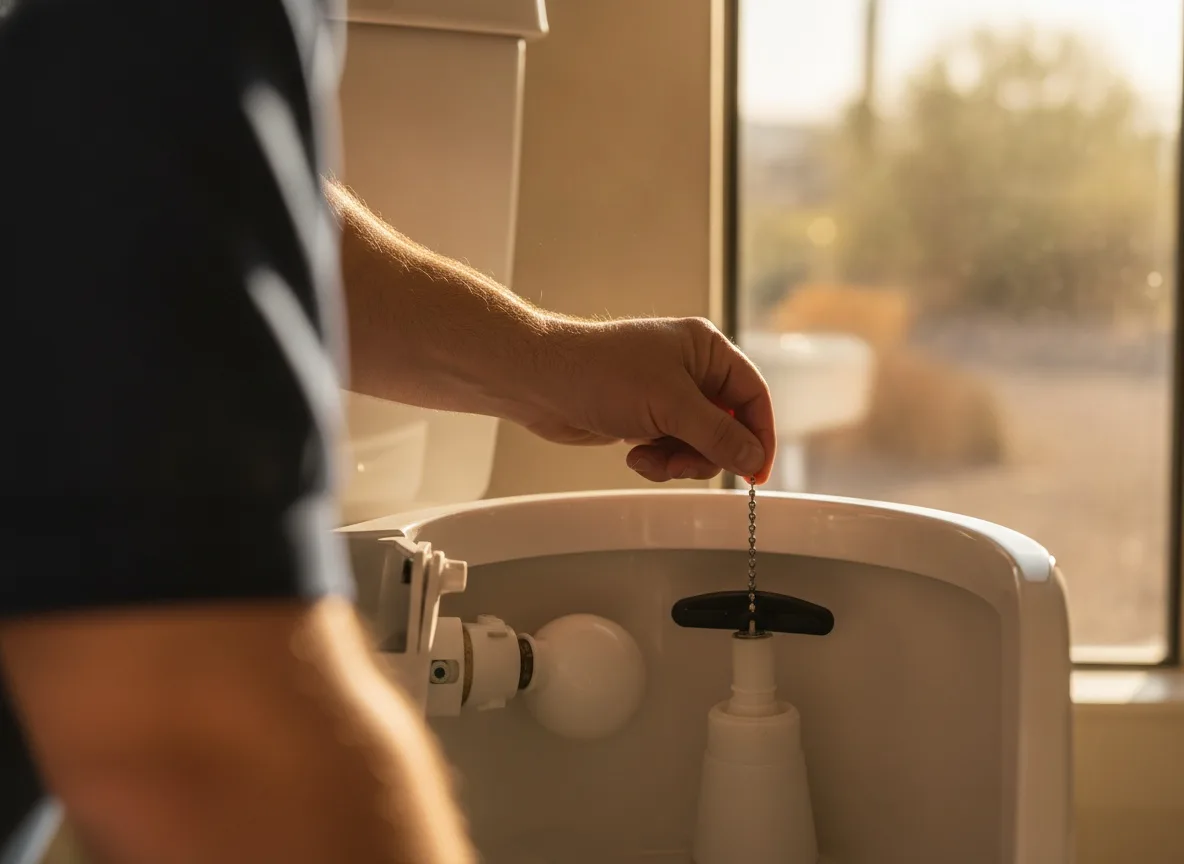
The plumbing inside a toilet tank is simpler than it looks. When you flush, a rubber seal at the bottom of the tank called the flapper lifts up and lets the tank water rush down into the bowl. Once the tank empties, the flapper drops back down and seals the hole. A part called the fill valve then refills the tank, and a float rides up with the rising water until it reaches the right level and shuts the water off. A small chain connects the flush handle to the flapper. When any one of these parts wears out or falls out of adjustment, the tank cannot seal or shut off the way it should, and the toilet runs.
The Four Usual Suspects Behind a Running Toilet
1. The Flapper (the Most Common Cause)
The flapper is the number one reason toilets run, because it takes the most wear. Over time the rubber gets stiff, warped, or coated with mineral scale from our hard Las Vegas water, and it stops sealing flat against the tank. Water then leaks past it into the bowl, the tank slowly drops, and the fill valve kicks on again and again to top it off. Lift the tank lid and watch the flapper after a flush. If it does not fall flat and seal, or if it looks brittle and stained, a new flapper is an inexpensive fix you can often handle yourself.
2. The Fill Valve
The fill valve is the tall part on the left side of the tank that refills it after each flush. When it wears out, it can fail to shut off all the way, so it keeps letting water in. You will often hear a faint hiss or a cycle that never quite stops. Sometimes you will see water trickling into the overflow tube, which is the open pipe in the middle of the tank. If the fill valve will not shut off cleanly even after you check the float, it is likely worn and needs replacing.
3. The Float
The float tells the fill valve when to stop. It rides on the surface of the water, and when the tank is full, it signals the valve to shut off. If the float is set too high, water rises past the level it should and spills into the overflow tube, which keeps the toilet running. If it is waterlogged or stuck, it may not shut the valve off at all. Many floats can be lowered with a small screw or clip on the fill valve, and that quick adjustment is often all it takes to stop the running.
4. The Chain
The chain links the flush handle to the flapper, and it causes trouble when the length is wrong. Too long, and it can slip under the flapper and hold it open a crack, letting water leak through. Too short, and it holds the flapper up so it never seals. Look for a chain with just a little slack when the flapper is closed. Moving the chain to a nearby hole on the flush arm is usually enough to get the slack right and let the flapper drop and seal.
Simple DIY Checks You Can Do in Ten Minutes
- Take the lid off the tank and set it somewhere safe. Do not worry, the water in the tank is clean.
- Flush and watch. See whether the flapper drops flat and seals, whether the water shuts off, and whether anything keeps trickling into the overflow tube.
- Check the flapper. If it looks warped, stiff, or scaled over, that is likely your problem.
- Check the chain. Make sure it has a little slack and is not caught under the flapper.
- Check the float. If water is spilling into the overflow tube, try lowering the float so the tank fills to just below the top of that tube.
- Run the dye test. Put a few drops of food coloring in the tank, wait about fifteen minutes without flushing, and check the bowl. If color shows up in the bowl, your flapper is leaking and should be replaced.
When to Stop and Call a Pro
Plenty of running toilets come down to a worn flapper or a float that needs a nudge, and those are fair game for a confident homeowner. But some problems are a sign of something bigger. If you have swapped the flapper and adjusted the float and the toilet still runs, if you see water on the floor around the base, or if you spot a crack in the tank or bowl, it is time to bring in a professional. That is exactly the kind of thing our Las Vegas plumbing repair team handles every day, and we always give you a flat-rate quote you approve before any work starts.
- The toilet keeps running after you have replaced the flapper and adjusted the float and chain.
- You see water pooling on the floor around the base of the toilet.
- There is a crack in the tank or bowl, or the tank sweats and drips constantly.
- The toilet rocks, runs, and drains slowly all at once, which can point to a bigger problem down the line.
- You would simply rather have it done right the first time by a licensed plumber.
A running toilet is one of those small problems that is easy to tune out and costly to leave alone, especially in a place as dry as Las Vegas. Most of the time, a ten-minute look inside the tank points you straight to the flapper, fill valve, float, or chain. When the fix is beyond a quick part swap, Kingdom Plumbing is here to help. We are family owned, licensed, bonded, and insured, a real person answers the phone day or night, and every job comes with our 100 percent satisfaction guarantee. Call us any time at (702) 840-5037.
Frequently Asked Questions
Why does my toilet keep running?
Is a running toilet a big deal?
Can I fix a running toilet myself?
When should I call a plumber for a running toilet?
Have a plumbing question or a problem right now?
Call (702) 840-5037Burst pipe or flooding that can't wait? Our 24/7 emergency plumbers in Las Vegas dispatch around the clock.