
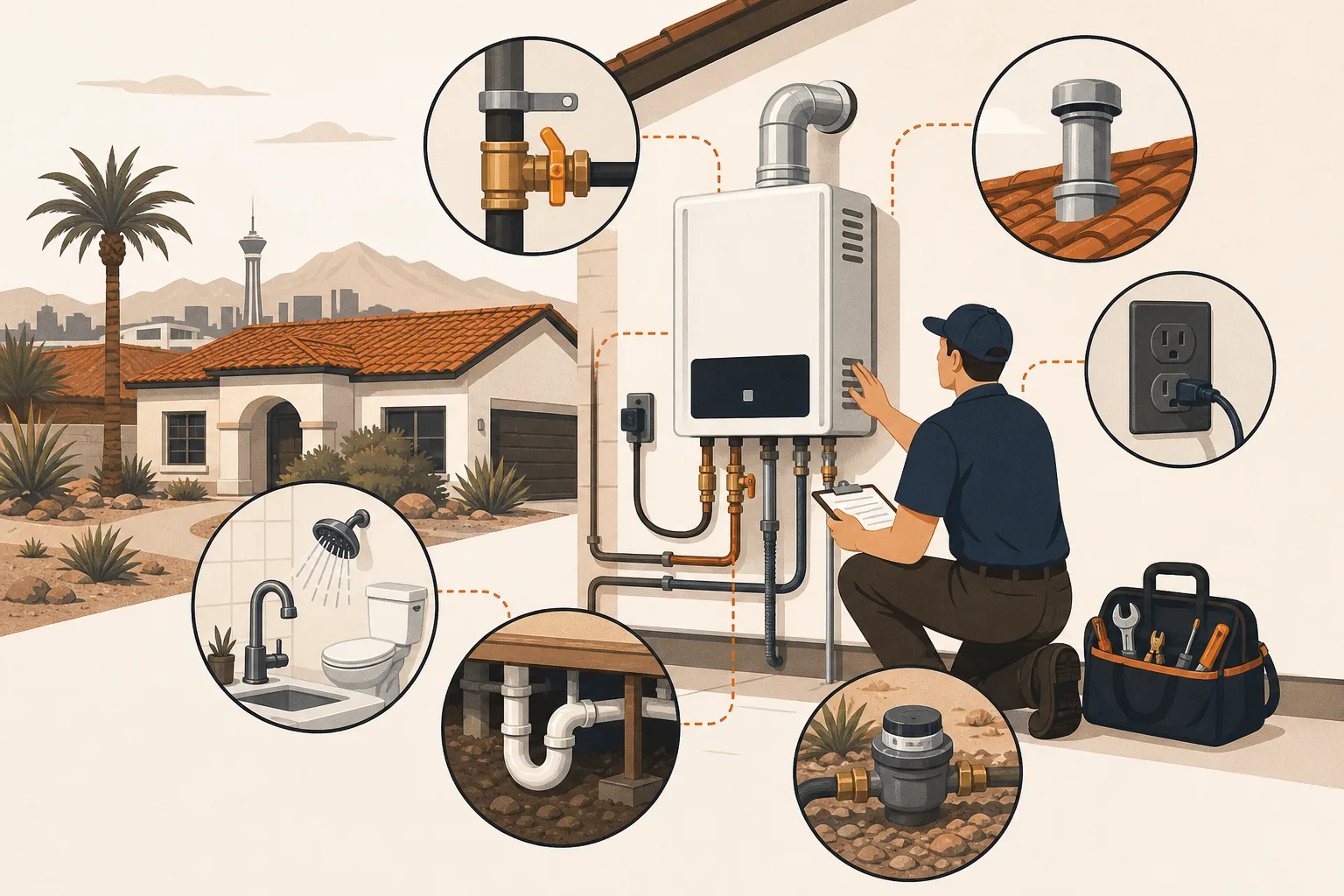
Las Vegas homes can often switch to tankless water heaters, but gas line size, venting, electrical, and our very hard water all affect whether it is a good fit. This guide walks you through what a licensed plumber checks so you can decide if a tankless water heater makes sense before you schedule an estimate.
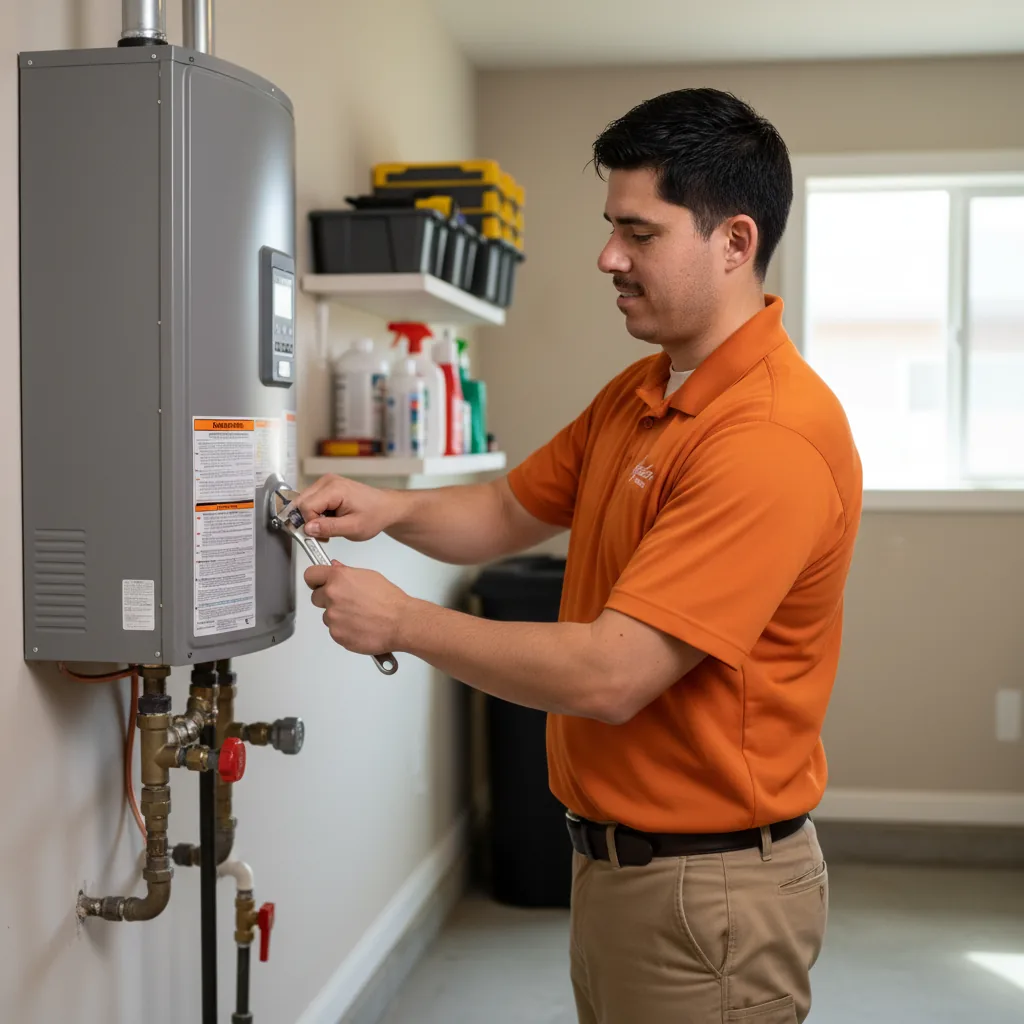
Can most Las Vegas homes realistically switch to a tankless water heater?
For many Las Vegas homeowners, going tankless sounds simple: take out the old tank and hang a new wall unit. In practice, a tankless water heater asks more from your gas, venting, and plumbing system than a standard tank, so a little homework upfront saves you from surprise costs. Tankless units heat water only when you open a tap, which means they need a much higher BTU input when they run, plus clear venting and, in many models, reliable electrical power for the controls and fan. The good news is that most slab-on-grade homes in the valley can be made tankless ready with the right upgrades.
The key question is not just “can it be done,” but “does it make sense for your home and budget.” National guidance from the U.S. Department of Energy estimates gas tankless water heaters can last around 17 to 20 years, compared to a shorter life for typical storage tanks, which is one reason many homeowners are interested in them. In our local experience, hard water and older gas piping can change that math. A feasibility visit from a licensed plumber focuses on sizing, code, and long-term maintenance in our desert conditions, not just squeezing a unit into the old water heater closet.
- Check that your gas service and meter can handle a higher BTU load
- Confirm there is a legal vent path to the exterior
- Verify electrical power is available where the unit will be mounted
- Evaluate if plumbing changes are needed to supply all fixtures
How does Las Vegas hard water change the tankless decision?
Las Vegas water is very hard, supplied mainly from the Colorado River through Lake Mead. The Las Vegas Valley Water District reports hardness around 291 parts per million, which is roughly 17 grains per gallon, in the “very hard” range. Hardness at that level lays down scale on any hot metal surface inside a water heater, including the heat exchanger in a tankless unit. If you install tankless without a plan for scale control, you may not see the long service life that national guides describe.
The U.S. Department of Energy and manufacturers note that gas-fired tankless heaters can deliver service lives on the order of 17 to 20 years when they are installed correctly and maintained. In our valley, regular descaling is not optional if you want to approach that life. Many manufacturers spell out maintenance requirements for hard water in their manuals and may tie warranty coverage to following those steps. When we evaluate a tankless water heater project, we talk about pairing it with a water softener or scheduling periodic flush and descale service so the very hard Las Vegas water does not shorten the investment you just made.
- Plan on regular tankless descaling in very hard water conditions
- Review manufacturer hardness limits before choosing a unit
- Consider a water softener to protect the tankless heat exchanger
- Budget for professional maintenance as part of total ownership cost
What gas line questions must be answered before going tankless in Clark County?
Gas piping is one of the biggest technical checks when you convert a Las Vegas home from a tank water heater to a tankless water heater. A storage tank spreads its heating across the day, so its burner input is relatively modest. A tankless unit has to heat water instantly, which means a much higher gas input when it runs. The Building America Solution Center highlights that undersized gas lines are a common mistake with gas tankless installations and can leave you with nuisance shutdowns, error codes, or lukewarm water when multiple fixtures run.
In Clark County, your plumber should calculate gas load for the entire home, then verify the pipe size and length from the meter to the new tankless location. This load calculation includes other appliances like your furnace, range, and dryer. If the line is not large enough, a new gas line run may be needed to meet manufacturer minimums and local code. Kingdom Plumbing’s flat rate planning ranges for this kind of work include tankless water heater installation at $7,900 to $9,900 and new gas line installation at $3,300 to $4,400, with gas line repair in the $325 to $900 range and gas leak searches at $375 to $850. These are planning ranges only, and every homeowner approves a flat rate before work begins.
- Confirm total gas load for all appliances in your home
- Measure existing gas line size and length from the meter
- Check for an accessible manual gas shutoff ahead of the heater
- Plan for a new gas line if calculations show the current one is undersized
What venting, combustion air, and electrical details matter for tankless units here?
Venting and combustion air are just as important as gas when you are evaluating tankless water heaters. The U.S. Department of Energy’s tankless measure guide explains that many conversions need new venting or combustion air provisions to match the specific unit and meet local code. In Las Vegas, your existing tank water heater may use a simple metal vent through the roof. A modern condensing tankless unit might need a different material, slope, and termination location, and sidewall venting is common if the heater moves to an exterior wall.
Clark County and the City of Las Vegas have adopted the 2024 Uniform Plumbing Code with local amendments, so a compliant installation checks more than just the vent pipe. Your plumber should confirm that vent materials are approved by the manufacturer, that clearances to windows, doors, and property lines are met, and that any intake and exhaust terminations will not recirculate flue gases in a tight side yard. Most tankless models also rely on electricity for their fan, ignition, and controls, so a standard receptacle within reach of the unit is necessary. If there is no nearby power, part of the project may include adding an electrical circuit in coordination with a licensed electrician.
How long does a tankless installation take and what does a complete job include?
Homeowners often ask how disruptive a tankless water heater installation will be. The U.S. Department of Energy notes that conversions can involve several trades, since plumbing, gas, venting, and electrical all touch the project. For a straightforward replacement where the tankless unit can go in roughly the same location and the gas line is adequate, much of the work can be completed in a day once permits are in place. More complex projects, such as moves to new locations or significant gas line upgrades, can take longer and may require access to walls or ceilings for piping and vent routing.
A complete code compliant job in the Las Vegas valley includes more than just hanging a new unit. The 2024 Uniform Plumbing Code with local amendments expects items like seismic strapping where required, an accessible gas shutoff ahead of the connector, and a sediment trap in the gas line. Relief discharge from the safety valve must terminate to an approved location, and, if the unit is located over living space, a pan with its own drain is needed. On a closed water system, the code also calls for thermal expansion control, which might be a separate expansion tank. Kingdom Plumbing installs thermal expansion tanks in the $350 to $400 range as part of that work when needed, and we handle the $600 to $700 permit so you are not dealing with the building department yourself.
- Removal and disposal of the old tank water heater
- New tankless unit placement and secure mounting
- Gas, water, and relief piping brought up to current code
- Startup, testing, and homeowner orientation on operation and maintenance
How much should Las Vegas homeowners budget for tankless installation and upkeep?
Cost is a major part of deciding whether to go tankless, especially when you are comparing it to another tank style water heater. For the Las Vegas valley, Kingdom Plumbing’s flat rate planning range for tankless water heater installation is $7,900 to $9,900, with a separate tankless install range of $5,600 to $6,300 if you supply the unit yourself. Every home is different, so these are planning figures rather than quotes, but they give you a realistic local benchmark instead of relying on national averages that often sit well below what code compliant work costs here.
On top of the core installation, some homes will see line items for related work. A permit typically falls in the $600 to $700 range. If your home needs a recirculation pump so bathrooms at the far end of a long slab-on-grade layout get hot water faster, Kingdom Plumbing’s planning range is $600 to $1,850. You might also invest in a water softener, which we install for $3,200 to $10,300, with common softener sizes often landing between $3,800 and $4,400. All of these are optional or situational, which is why a walkthrough with a licensed, bonded, and insured plumber is so important before you commit.
- Confirm your household’s hot water habits by counting how many showers, faucets, and appliances you want to run at the same time so your plumber can size the tankless unit correctly.
- Locate your current water heater and think about whether that spot offers a good vent path and access or whether you might want the tankless unit moved to a different wall.
- Gather basic information about your gas appliances and send it to your plumber in advance so they can estimate your total gas load and whether your existing piping is likely to be adequate.
- Decide if you care more about endless hot water at multiple fixtures, lower energy waste, space savings, or a combination of those so your plumber can recommend the right model type.
- Ask a licensed plumber to inspect your water quality and discuss whether a water softener or regular descaling schedule is needed to protect a future tankless water heater in our very hard water.
- Set a realistic budget using local flat rate planning ranges for tankless water heater installation, permits, recirculation, and any gas or vent upgrades your home may require.
- Request that your plumber walk you through how the 2024 Uniform Plumbing Code with Southern Nevada amendments applies to your installation so you know what “up to code” will include.
- Plan ahead for maintenance by asking how often a tankless water heater in Las Vegas should be flushed and descaled, and whether annual service can be scheduled at the same time each year.
- Clarify whether you will supply the tankless unit or have your plumber provide it so you understand how that choice affects warranty handling and the installation price range.
- Schedule a diagnostic visit so a licensed, bonded, and insured plumber can confirm feasibility in person before you remove your existing water heater or make electrical changes.
Frequently asked questions
- Can my Las Vegas home handle a tankless water heater without major upgrades?
- Many Las Vegas homes can support a tankless water heater with modest changes, but it depends on your gas line sizing, venting options, and electrical access. A plumber should check your total gas load, the size and length of piping from the meter, and whether there is a safe vent path. If those line up well, the project may be straightforward. If not, you might need a new gas line or relocated unit to do it right.
- How does Las Vegas hard water affect tankless water heater life?
- The Las Vegas Valley Water District reports that our water hardness is about 16 to 17 grains per gallon, which is considered very hard. This level of hardness can quickly build scale inside a tankless heat exchanger unless it is flushed and descaled regularly. National sources suggest a 17 to 20 year life for tankless water heaters, but in this valley you will only approach that if scale is controlled through maintenance or treatment. Plan on regular service and discuss water treatment with your plumber before you install.
- Do I need a bigger gas line to install a tankless water heater?
- You might. Tankless water heaters usually have a much higher gas input than tank style heaters because they heat water on demand, and the Building America Solution Center notes that undersized gas lines are a common problem. Your plumber will calculate the total BTU load for all gas appliances and compare that to the size and length of your existing piping. If the line is undersized, a new gas line run or meter upgrade may be part of the project.
- What code requirements apply to tankless water heater installs in Las Vegas?
- Clark County and local cities use the 2024 Uniform Plumbing Code with Southern Nevada amendments, which affects water heater work. A compliant tankless installation typically includes a permit, proper venting to the exterior, an accessible gas shutoff, seismic strapping where required, and a sediment trap on the gas line. If the unit is over living space, a drain pan with its own outlet is expected, and the temperature and pressure relief line must terminate to an approved location, not into that pan.
- How much does it cost to install a tankless water heater in the Las Vegas valley?
- For planning purposes, Kingdom Plumbing’s flat rate range for tankless water heater installation is $7,900 to $9,900, with a separate range of $5,600 to $6,300 if you supply the unit. Permits usually add $600 to $700, and some homes also need a recirculation pump in the $600 to $1,850 range or a new gas line in the $3,300 to $4,400 range. These are not quotes, but they give you realistic local numbers to budget around before a technician evaluates your specific home.
- How long will I be without hot water during a tankless water heater install?
- In a typical conversion where the tankless unit goes near the old tank, most of the work can be done in one working day once permits are ready. You will lose hot water while the old heater is removed, connections are updated, and the new tankless unit is commissioned. More complex projects that involve new gas lines, vent runs, or moving the location can take longer, which your plumber should explain during the estimate.
- Is a recirculation pump worth adding to a tankless water heater in a Las Vegas tract home?
- Many Las Vegas tract homes have long hot water runs across a slab-on-grade foundation, which can mean a noticeable wait at far bathrooms even with a tankless water heater. A recirculation pump can shorten that wait by keeping hot water closer to fixtures, especially in larger single story floor plans. Kingdom Plumbing’s planning range for a recirculation pump is $600 to $1,850, and it is often discussed at the same time as the main tankless water heater estimate so you can decide based on your layout and budget.
Talk to Kingdom Plumbing about tankless water heaters, or call (702) 840-5037. Family-owned, NV Contractors License #0085422, upfront flat-rate pricing.
Kingdom Plumbing is a family-owned, licensed Las Vegas plumber (NV NV Contractors License #0085422) serving the valley since 2018. Questions about how this affects your home? Call (702) 840-5037. Dealing with a burst pipe or flooding right now? Our emergency plumbers in Las Vegas answer 24/7.