
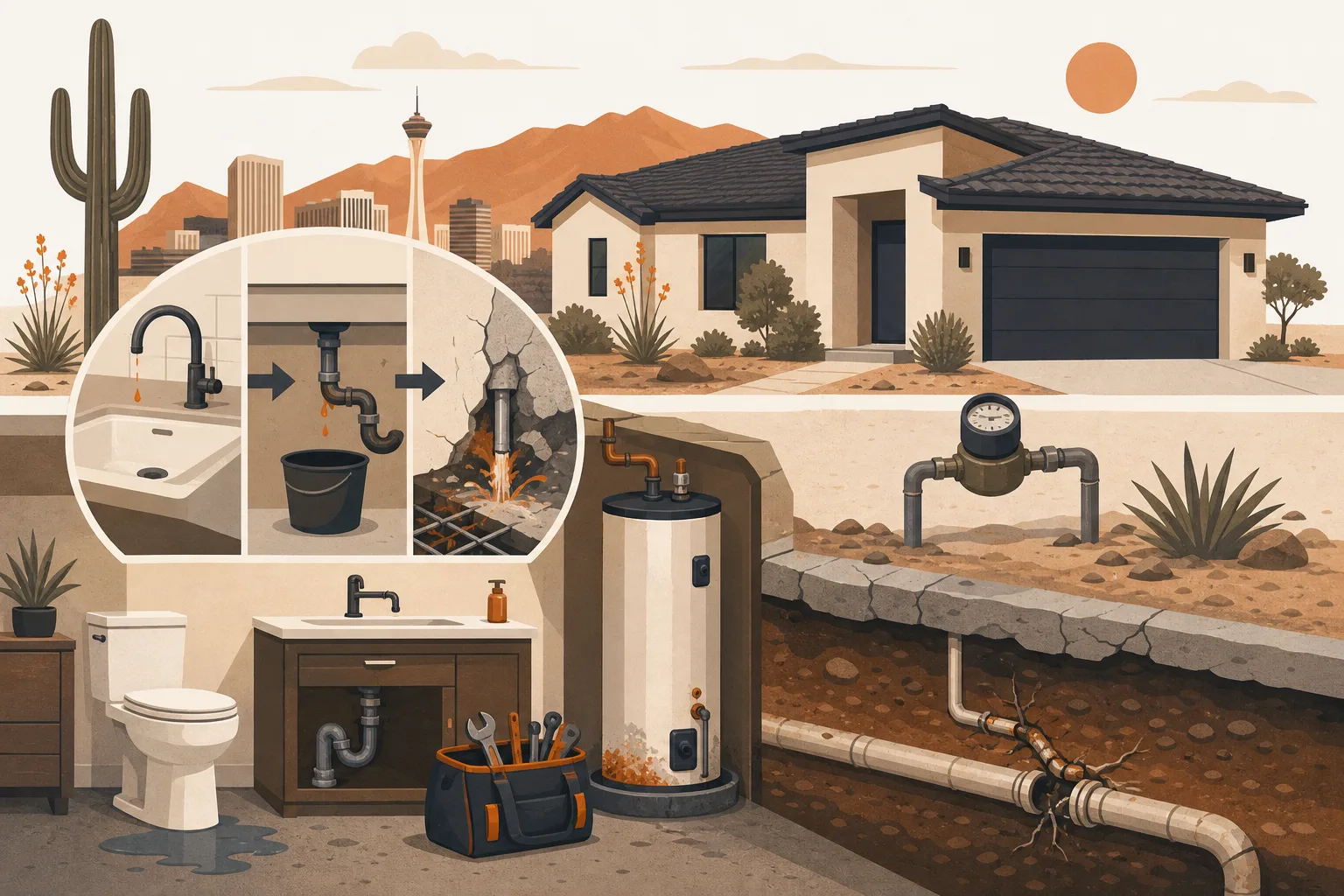
Many Las Vegas homeowners still try to “wait and see” during a plumbing emergency or rely on quick DIY patches. In our desert valley with slab-on-grade homes and very hard water, that old approach often turns a small repair into a major, code-driven project.
Why the old “wait and see” approach fails in Las Vegas plumbing emergencies
For years, many Las Vegas homeowners have handled plumbing problems the same way: shut a door, put down a towel, and hope it looks better in the morning. That approach might work in a basemented home back east, but it is a bad fit for the slab-on-grade construction we have across the valley. With no basement and plumbing buried in concrete, water has fewer places to show itself and more opportunities to spread sideways under finishes before you see the full extent.
Local conditions magnify the risk. The Las Vegas Valley Water District reports our water hardness at around 280 to 291 parts per million, about 16 to 17 grains per gallon, which is classified as very hard. That mineral load encourages pinhole leaks, scale-clogged lines, and stressed fixtures. When a supply line bursts in a wall or under a slab, every extra hour allows more water to move through cracks, into caliche soil, and back into your flooring, instead of dripping into a visible basement. In that setting, waiting to see if it clears up is really choosing not to see how much damage is already being done.
The same issue applies to sewer and drain emergencies. A slow toilet in the afternoon can become a full sewer backup that night, especially in older neighborhoods where mature tree roots chase sewer lines. What feels like a minor inconvenience can quickly threaten flooring, baseboards, and cabinets. That is why a modern emergency plumbing response focuses first on fast stabilization and not on monitoring a problem that is actively worsening.
Emergency plumbing is not just about convenience either. If a leak reaches electrical, creates unsafe walking surfaces, or leaves a home without basic services, it moves from nuisance to a safety and habitability issue. In those situations, the old approach of waiting until business hours can be more expensive than an after-hours call. According to Kingdom Plumbing’s own guidance, one of the most common mistakes they see is simply delaying the first call while water finds new paths to travel.
- Slab-on-grade floors hide spreading leaks until they reach edges.
- Very hard water encourages faster wear on pipes and fixtures.
- Slow drains can turn into full sewer backups overnight.
- Delaying a call lets minor issues cross into safety concerns.
What actually counts as a plumbing emergency in the Las Vegas valley
Many homeowners are unsure what truly qualifies as a plumbing emergency, especially when after-hours rates are involved. In practical terms, an emergency is any plumbing issue that cannot reasonably wait without risking serious property damage or loss of essential service. Examples include active leaks that will not stop at a fixture valve, sewage backing up into tubs or showers, a burst supply line, or a main shutoff that will not close. In our desert climate, an extended total water outage can also be treated as urgent, particularly in extreme heat.
Guidance from emergency plumbing services in the valley notes that response times for urgent calls are typically in the 60 to 90 minute range once the call is dispatched. Simple diagnostics often take 15 to 30 minutes after arrival, while more complex issues such as slab leak detection can take longer due to concrete and finishes. The goal in a true emergency is not necessarily to complete every last repair in a single visit, but to stop the immediate damage and restore safe use of the home as quickly as conditions allow.
It also helps to distinguish between issues that feel urgent and issues that are inconvenient. A dripping faucet or a running toilet wastes water, but usually does not require a middle-of-the-night visit. On the other hand, water appearing where it should never be, like from light fixtures, at the base of walls, or through grout lines, is a red flag on a slab foundation. In those cases, it is appropriate to use emergency plumbing service to shut down the water safely, find the active leak, and plan the next steps.
Thinking clearly about what is and is not an emergency helps you use emergency plumbing services wisely. You avoid overpaying for simple problems that can wait until morning, while still acting decisively when a delay would raise the risk of mold, structural damage, or loss of basic sanitation. If you call Kingdom Plumbing, a licensed technician can help you sort that line over the phone and advise you on whether to treat your issue as urgent or schedule the first regular appointment of the day.
How the old DIY-first mindset backfires during real emergencies
Another common old habit is to reach for quick fixes and DIY tools first, then call for emergency plumbing only after those attempts fail. In the valley, that sequence often wastes the most valuable resource in an emergency: time. For example, pulling a toilet to clear a clog, only to discover a deeper main line blockage, can leave you with an unusable bathroom and a larger mess than when you started.
Clark County’s Plumbing Repair & Service Building Permit Guide explains that some repairs, such as clearing stoppages, removing and reinstalling toilets, or stopping leaks in exposed piping, do not require permits as long as you are not rearranging concealed lines. That can give homeowners a sense that many emergency-related tasks are fair game for DIY work. The catch is that in an active emergency, misdiagnosis is costly. What presents as an exposed drain clog might be the symptom of a failed underground line, and continuing to run water while you experiment with tools can push waste into tubs and showers.
Similarly, temporary patches on pressurized water lines, such as compression fittings or tape over pinholes, may hold for a short time but are not designed as long-term solutions. In our very hard water environment, corrosion and scale buildup around a compromised area mean the surrounding pipe is often weakened as well. A slight bump, pressure surge, or temperature change can make a small problem reopen or even fail more dramatically, sometimes after you have gone to bed thinking you have solved it.
A modern, safe approach in a real emergency uses DIY steps only for immediate risk reduction, like shutting off a fixture, closing the main valve, or moving belongings out of harm’s way. The actual troubleshooting and repair is then handed to a licensed emergency plumbing professional with the right diagnostic tools, knowledge of local code, and ability to stabilize the system in a single organized visit rather than several rounds of trial and error.
- DIY drain clearing can worsen backups if the main line is compromised.
- Temporary patches on pressurized lines may fail without warning.
- Misreading a symptom can delay the right fix by critical hours.
- Professional diagnostics avoid repeated trial-and-error attempts.
How Las Vegas codes and permits change what an emergency plumber really does
A big reason old habits fall short is that plumbing work in Southern Nevada now operates under updated rules. Clark County and the City of Las Vegas adopted the 2024 Uniform Plumbing Code with local amendments in 2026, and that changes what a truly complete repair can involve. While the county’s Building Permit Guide BPG-154 makes clear that some emergency repairs, like stopping leaks in drains or clearing stoppages, can be done without a permit, other work on concealed piping and major system changes does require permits and inspections.
During an emergency visit, a licensed plumber separates what must be addressed right away from what must be brought up to code over the full repair. For example, a technician may cap a leaking line or isolate a bathroom to stop active damage, then explain which follow-up work will trigger permitting. That can include replacing sections of concealed piping, rerouting water lines in a slab-on-grade home, or making corrections the 2024 code now requires when you modify certain parts of the system.
Code compliance also affects appliances connected to water and gas, such as water heaters, though those are usually addressed in separate, non-emergency projects unless there is an immediate safety hazard. Local rules involve items like seismic strapping, accessible gas shutoffs ahead of connectors, and correctly routed temperature and pressure relief drains. While those details matter more during planned replacements, an emergency plumber still has to consider them if a crisis uncovers unpermitted or unsafe work.
For a homeowner, this means an emergency plumbing call is not just a stopgap. It is the first step in a process that might involve documentation, inspections, and bringing older or improvised work into alignment with current standards. A good plumber will be transparent about which tasks fall under “no permit required,” which will need drawings and inspections, and how those decisions affect timing and cost. That clarity helps you compare quotes fairly and avoid being surprised when a job grows beyond a simple patch.
What a modern emergency plumbing visit in Las Vegas should look like
Knowing what good looks like in an emergency plumbing visit helps you spot the difference between an old-fashioned band-aid and a modern, professional response. According to Kingdom Plumbing’s own guidance on emergency calls, the visit usually starts before a truck ever rolls. When you call, you should get help locating and shutting off the main water valve or specific fixture valves if it is safe to do so, and coaching on basic safety like staying clear of wet electrical or ceiling sagging under water weight.
Once on site, an emergency plumber typically aims to stabilize within minutes. That can mean stopping active leaks, pumping down standing sewage to prevent further spread, or capping failed lines. After that, there is a focused diagnostic phase, which for typical emergencies often runs 15 to 30 minutes, though more complex cases like suspected slab leaks can take longer, especially in homes with tile throughout. The technician should explain what they are testing, what they see so far, and which parts of your home are directly affected.
A critical part of a modern emergency service visit is clear communication about scope, timing, and flat-rate costs. Kingdom Plumbing, for example, uses upfront flat-rate pricing that you approve before work starts, whether it is a drain clearing service or a leak detection. In a true emergency, the plumber might recommend a temporary stabilization now, then a scheduled return visit for non-urgent, code-related corrections once everything is safe. That plan should be documented so you can review it calmly after the crisis has passed.
Finally, before leaving, your plumber should confirm what fixtures you can use, what should remain off, and what to watch for over the next 24 hours. They should also advise when to call back immediately, such as if you notice new wet spots on a slab floor, hear water running when all fixtures are off, or see sewage return. When handled this way, an emergency plumbing visit becomes a controlled event instead of a scramble, and you finish the day with a clear path to full repair, not just a mystery bill and a lingering worry.
- Locate and test your main water shutoff valve now, before an emergency, so you can close it quickly if a pipe bursts.
- Learn where individual fixture shutoff valves are for toilets, sinks, and appliances so you can isolate a problem room without losing water to the whole house.
- Save a licensed emergency plumbing company’s number, such as Kingdom Plumbing at (702) 840-5037, in your phone so you are not searching online while water is spreading.
- Walk the home and note any past signs of moisture on walls, ceilings, or slab floors so you can mention them to the plumber if a new emergency occurs.
- Review Clark County’s basic no-permit-required guidance so you understand which quick stabilizing repairs can proceed immediately and which may involve future inspections.
- Ask your insurance agent what kinds of water damage and emergency plumbing visits your policy covers so you are not guessing in the middle of a crisis.
- Talk with your household members about a simple emergency plan that covers who calls the plumber, who moves valuables, and who stays clear of affected areas.
- When a problem first appears, take clear photos and short videos of leaks or backups before attempting any cleanup so you can show accurate conditions to your plumber and insurer.
Frequently asked questions
- What counts as a real plumbing emergency in Las Vegas?
- A real plumbing emergency is any issue that risks serious damage or loss of essential service if you wait. Examples include active leaks that will not stop at a valve, sewage backing into tubs or showers, a burst supply line, or a main shutoff that fails. In our slab-on-grade homes, water appearing through floors or at the base of walls is also a strong sign to call for emergency plumbing service immediately.
- How fast can an emergency plumber usually get to my Las Vegas home?
- Local emergency plumbing FAQs report that in the Las Vegas valley, urgent calls typically see a crew arrive within about 60 to 90 minutes, depending on traffic and call volume. Once on site, straightforward diagnostics often take 15 to 30 minutes, while more complex problems such as potential slab leaks can take longer. Response time should be discussed on the phone when you call so you know what to expect.
- Should I try to fix a plumbing emergency myself before calling a plumber?
- In a true emergency, your DIY work should focus on safety steps only, such as shutting off the main water or a fixture valve and moving belongings out of danger. Deeper work like pulling toilets, opening walls, or experimenting with drain snakes can waste valuable time and sometimes make damage worse. A licensed emergency plumbing technician has the right tools and training to stabilize the situation and keep you in compliance with local code.
- Do I need a permit for emergency plumbing repairs in Clark County?
- Clark County’s Building Permit Guide BPG-154 states that certain repairs such as stopping leaks in exposed pipes or clearing drain stoppages, including removing and reinstalling toilets, do not require permits as long as concealed piping is not being rearranged. Larger repairs that replace or reroute hidden piping typically do require permits and inspections. A licensed plumber can explain which parts of your emergency repair fall into each category and plan the permitted work accordingly.
- Why are plumbing emergencies in Las Vegas worse than in other cities?
- Two local factors raise the stakes here: very hard water and slab-on-grade construction. The Las Vegas Valley Water District reports hardness around 16 grains per gallon, which accelerates wear on pipes and fixtures. At the same time, with plumbing buried in concrete slabs instead of basements, leaks can travel sideways and stay hidden longer, so every hour of delay tends to spread damage farther under flooring and walls.
- What should I expect during an emergency plumbing visit from Kingdom Plumbing?
- You can expect help over the phone with shutting off water if needed, followed by a prompt arrival aimed at stabilizing the situation quickly. The technician will diagnose the problem, explain what they find, and present a flat-rate price that you approve before work starts. If the emergency reveals code or permit issues that need longer-term solutions, they will outline a clear plan for follow-up work so you know exactly what comes next.
Talk to Kingdom Plumbing about emergency plumbing, or call (702) 840-5037. Family-owned, NV Contractors License #0085422, upfront flat-rate pricing.
Kingdom Plumbing is a family-owned, licensed Las Vegas plumber (NV NV Contractors License #0085422) serving the valley since 2018. Questions about how this affects your home? Call (702) 840-5037. Dealing with a burst pipe or flooding right now? Our emergency plumbers in Las Vegas answer 24/7.