
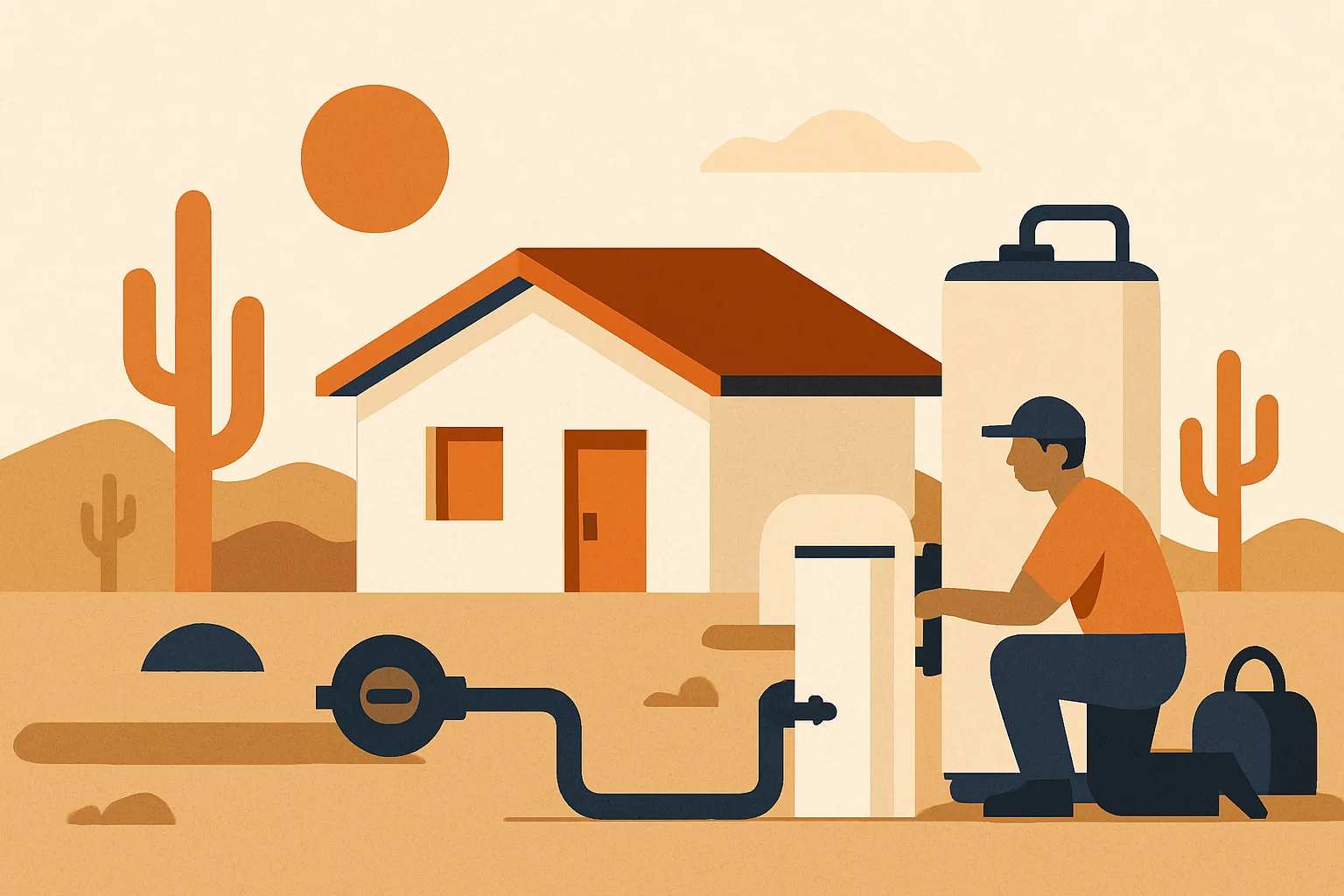
Nevada’s Assembly Bill 96, in effect since July 1, 2026, now requires Clark County to plan for public cooling spaces and safe drinking water during extreme heat. For Las Vegas homeowners, this changes how local agencies prepare for heat emergencies and highlights why your own plumbing needs to be ready before a crisis hits.
What does Nevada’s new heat mitigation law AB 96 actually do in Clark County?
Assembly Bill 96 is now in effect statewide as of July 1, 2026. According to reporting on the new law, it requires Clark County and Washoe County to add a formal heat mitigation strategy into their master plans. That plan must include public cooling areas, drinking water access, and shade structures so residents have safer places to go when temperatures climb. For those of us living in the Las Vegas valley, this means local planners are now required to think ahead about how people stay cool, hydrated, and safe in long-term heat waves.
The law is not a plumbing code update and it does not directly change what you can or cannot install in your home. Instead, it shapes how county agencies and cities prepare on a larger scale. You should expect more focus on public cooling sites, better signage about where to find drinking water, and possibly more coordination during regional emergencies that combine power, heat, and water issues. From a homeowner’s point of view, it is a reminder that water access and heat safety can become serious problems very quickly in Las Vegas, especially if your home’s plumbing has hidden weaknesses.
Because the law is tied to Clark County’s master planning, the changes will roll out over time. You will not see a county inspector knocking on your door because of AB 96 alone. However, as infrastructure planning tightens around heat events, private homes that are not ready for pressure spikes, flood events, or drain backups may feel the pinch first when the public side of the system is under strain. That is where proactive checks and having reliable emergency plumbing support come in.
- Applies directly to Clark County master planning, not individual homes
- Requires public cooling spaces to be part of long-term plans
- Requires public drinking water and shade structures to be included
- Highlights the growing risk that extreme heat poses to water access
How could a public heat mitigation law lead to more home plumbing emergencies?
Extreme heat by itself does not usually crack a pipe inside your walls, but it magnifies every weak spot in a plumbing system. When Clark County responds to a heat wave with more cooling stations and higher public water use, the demand on the overall system can rise. In some neighborhoods, that may show up at home as pressure fluctuations, longer pump cycles, or slower drainage if multiple systems are working near capacity. Your home plumbing should be able to ride through that kind of stress without failing, yet older homes or those with past DIY fixes often cannot.
Heat also changes how your household uses water. People tend to shower more, run evaporative coolers longer, and rely heavily on ice makers and fridges. In the Las Vegas valley, our water is already quite hard, which can build scale inside supply lines and fixtures over time. When hot weather hits, that mineral build up and extra usage can combine to push a marginal fixture over the edge, turning a slow drip into a burst, or a minor clog into a full blockage. during extreme temperatures, any emergency plumbing situation is more dangerous because you cannot simply go without water for long.
AB 96 itself does not generate those emergencies, but it signals that state leaders see extreme heat as a long-term reality. For a homeowner, the takeaway is straightforward. If the state is planning structurally for heat impacts on water access, it is wise for you to plan at the house level. That means eliminating known leaks, replacing aging shutoff valves, and understanding when you should call a professional the moment you notice changes like sudden low pressure, sewer smells, or water discoloration during a heat event.
- Higher public water demand can magnify pressure swings at home
- Heat pushes families to use more showers, ice, and cooling equipment
- Hard water and scale make pipes and fixtures more fragile under stress
- Emergency plumbing issues are riskier when outdoor temperatures are extreme
Does Assembly Bill 96 change what Las Vegas homeowners are required to do with plumbing?
Right now, AB 96 does not create any new homeowner-specific plumbing requirements in Clark County. You do not need to replace fixtures or upgrade pipes just because this law passed. Existing building codes and permit rules still govern when you must pull a permit, when a project needs inspection, and what materials are allowed. Those rules come from local building departments and plumbing codes, not directly from AB 96.
Where the law does affect you is in expectations. As Clark County updates its master plan, you can expect stronger emphasis on resilience, including water and cooling during extreme heat. That can influence future neighborhood infrastructure, from how new lines are sized to how outage plans are written. When there is a major heat-driven event, public agencies may also coordinate more tightly with utilities, which can change how and when they shut down parts of the system to protect it. If your home plumbing has known vulnerabilities, such as questionable repairs or old main shutoff valves that barely turn, those moments are when small issues can quickly turn into emergencies.
In practice, this is a good window to check that your own system lines up with local expectations for safety and reliability. You are not required to schedule an inspection because of AB 96, but many homeowners choose to have a professional look for weak supply hoses, corroded shutoffs, or aging water heaters before they fail in hot weather. If a surprise failure does catch you, a 24/7 emergency plumbing service gives you a path to control damage and keep your family safer while the wider public system is under heat stress.
- No new plumbing permit rules are created directly by AB 96
- Local building codes still control what work requires inspection
- Clark County planning may gradually influence infrastructure near your home
- Using this window to fix known plumbing issues is a smart voluntary step
What kinds of plumbing problems become emergencies faster during Las Vegas heat waves?
When temperatures stay very high, certain plumbing issues move from nuisance to emergency much faster. Loss of cold water to an entire home is a clear emergency in Las Vegas heat, especially for older adults, young kids, or anyone with health conditions. During a heat wave or when the county is acting under its heat mitigation plans, you may not have the option to stay elsewhere, so getting water restored quickly matters. That is where professional emergency plumbing, with same day or overnight response, can be the difference between discomfort and a medical risk.
Sewer backups are another issue that escalates during extreme heat. Waste sitting in lines for any length of time can lead to strong odors, bacterial growth, and unsafe living conditions. High outdoor temperatures accelerate all of that. Backups can also be triggered by higher total use on neighborhood lines when people in your area are running more showers, laundry, and cooling equipment. In those situations, a slow drain on a mild day can become a full backup in a few hours.
Even leaks that might seem minor can qualify as emergency plumbing problems when the heat is intense. A slab leak can introduce moisture that raises indoor humidity, strains your air conditioning, and encourages mold growth. A broken supply line in an attic can soak insulation and ceiling materials at the same time you are trying to keep cooled air inside. In a valley with hard water and slab-on-grade construction, ignoring these signs is rarely a good idea. A professional can quickly determine whether shutting off a fixture is enough or if a full repair is needed right away.
- Total loss of water service to your home
- Sewer line backups or repeated toilet overflows
- Slab leaks that add hidden moisture during high heat
- Burst supply lines in walls, ceilings, or attics
How should Las Vegas homeowners coordinate personal preparedness with county-level heat plans?
County planners, responding to AB 96, will focus on the big picture. They will look at where to locate public cooling rooms, how to provide safe drinking water, and how to add shade in public areas. Your part is to make sure that when you walk back through your front door, your own systems are as dependable as they can be. That starts with understanding where your main shutoff is, how to use it, and what your highest risk plumbing components are, such as older flexible hoses or water heaters near the end of their life.
You do not need to match the county’s planning process, but you can borrow the basic idea. Think about what heat does to your household. If the county is planning for public water access, you can plan for private water reliability. That may include having a professional check your pressure, test key shutoff valves, and look for discoloration or corrosion on exposed plumbing. It also means learning what counts as a genuine emergency plumbing problem so you do not hesitate during a heat wave when quick action would protect your home.
Las Vegas homes often sit on slab foundations and deal with hard water from valley sources. Those two factors alone create a higher baseline risk of hidden leaks and scale buildup, especially in older properties. Coordinating your personal steps with the public plans simply means treating your home as the last critical link in the chain. If you see new wet spots, hear running water when fixtures are off, or smell sewer odors during prolonged heat, your first call should be to a licensed plumber who can respond quickly and safely.
- undefined
- undefined
- undefined
- undefined
- undefined
- undefined
- undefined
- undefined
Frequently asked questions
- What is Nevada Assembly Bill 96 and how does it affect Las Vegas homeowners?
- Assembly Bill 96 is a state law that took effect on July 1, 2026 and requires Clark County and Washoe County to include a formal heat mitigation plan in their master plans. The law focuses on public cooling spaces, drinking water access, and shade structures. It does not directly change residential plumbing codes, but it signals that heat-related water issues are a long-term concern. Homeowners should treat it as a prompt to make sure their own plumbing is ready for extreme heat events.
- Does AB 96 mean I have to upgrade my home’s plumbing in Las Vegas?
- No, AB 96 does not force any specific plumbing upgrades in private homes. Your responsibilities are still defined by local building codes and permit rules. However, because the law highlights how important water and cooling are during heat waves, it is sensible to address known leaks, weak fixtures, or unreliable shutoff valves now. That way your home is less likely to have an emergency when the public system is under heat stress.
- What plumbing issues should I treat as an emergency during a Las Vegas heat wave?
- Any total loss of water service, significant leak you cannot contain, or sewer backup should be treated as an emergency in high heat. In Las Vegas, going without water or dealing with sewage during extreme temperatures can quickly become a health and safety problem. If you are unsure, err on the side of caution and call an emergency plumbing service to describe your situation. A licensed plumber can advise whether you need same day help or a scheduled visit.
- Can extreme heat really cause pipes to burst in Las Vegas homes?
- Heat usually does not burst pipes by itself, but it can push already stressed systems over the edge. High temperatures increase overall water use, which can change pressures in the system, and they also expand some materials slightly. In combination with hard water scale and older fittings, that extra stress can trigger failures. That is why inspections and timely replacement of weak components are important before the hottest periods of the year.
- How does AB 96’s focus on public drinking water connect to my home plumbing?
- The law’s public drinking water requirement is about ensuring people have safe places to hydrate when it is dangerously hot outside. It does not reach into your home, but it emphasizes that stable water access is a public safety issue. If the county is planning at that scale, it is a good time to look at your own plumbing and ask whether a leak, clog, or failing water heater could leave your household without reliable water during a heat event.
- When should I call a 24/7 emergency plumbing service instead of waiting for normal hours?
- You should call emergency plumbing if water is flowing where it should not be, if sewage is backing up, or if you lose water service to all or most fixtures and cannot identify a simple cause. These problems can damage property quickly and are more dangerous when it is very hot. If turning off a single fixture stops the problem and you still have full water access, a regular appointment may be fine, but in doubt it is wise to speak with a plumber anytime of day.
Talk to Kingdom Plumbing about emergency plumbing, or call (702) 840-5037. Family-owned, NV Contractors License #0085422, upfront flat-rate pricing.
Kingdom Plumbing is a family-owned, licensed Las Vegas plumber (NV NV Contractors License #0085422) serving the valley since 2018. Questions about how this affects your home? Call (702) 840-5037. Dealing with a burst pipe or flooding right now? Our emergency plumbers in Las Vegas answer 24/7.
More Updates
- How Long Does Garbage Disposal Repair and Installation Take in Las Vegas?
- Doing toilet work yourself vs hiring a licensed plumber: where the line really is in Las Vegas
- July 2026 Colorado River Record Lows: The Plumbing It Stresses And What To Do Before More Heat
- September 2026 Lake Mead shortage tier: what it means for a Las Vegas home's water