
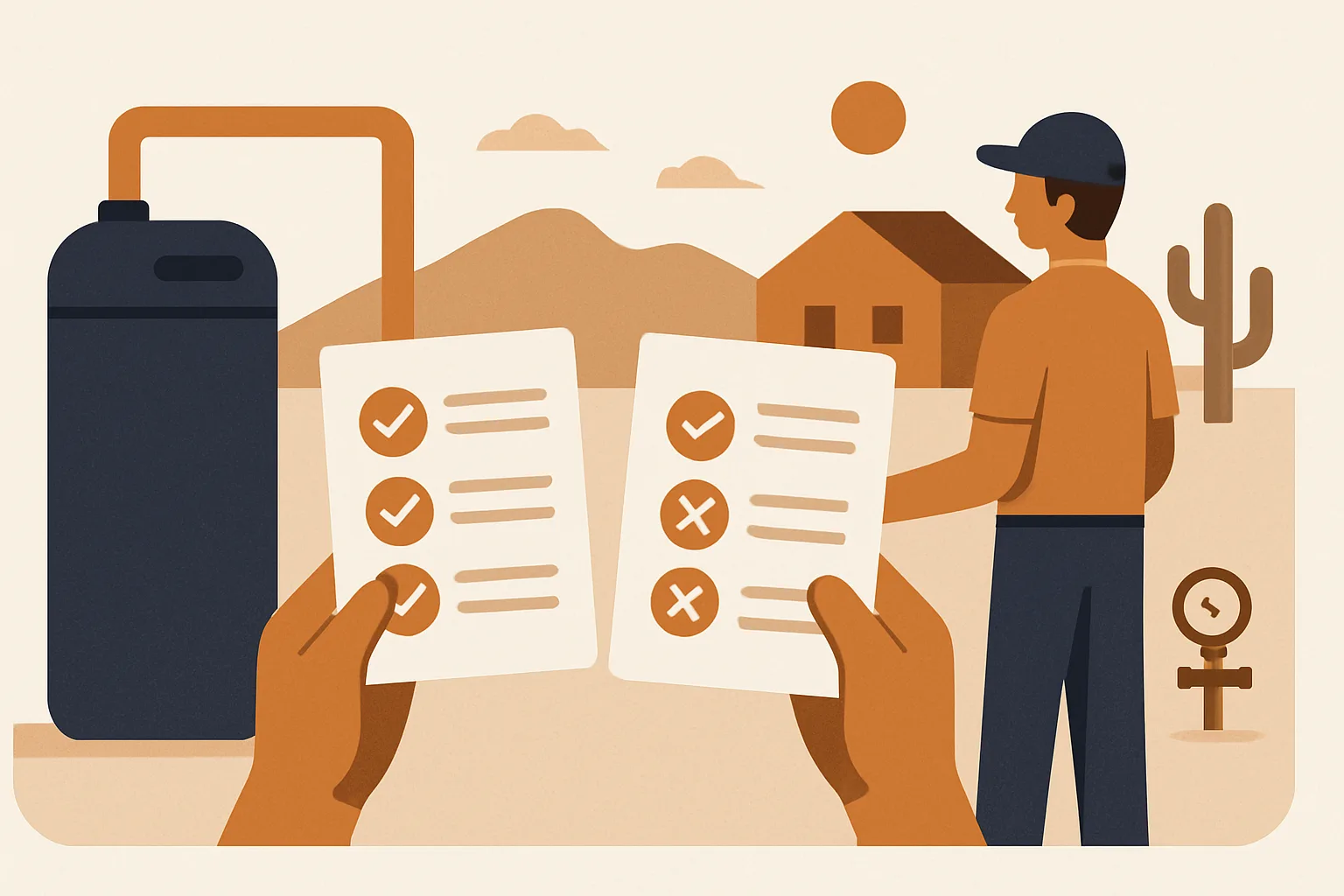
Las Vegas water is very hard, so many homeowners eventually install a water softener or full water treatment system. Here is how to read competing quotes side by side, what a fair price range looks like, and how to spot warning signs before you sign anything.
Why Las Vegas homeowners should be picky about water softener quotes
If you own a home in the Las Vegas valley, you are living with very hard water. The Las Vegas Valley Water District reports hardness around 280 parts per million, which is about 16 grains per gallon, and that falls in the “very hard” category. With water that hard, a properly sized and correctly installed water treatment and softener system can protect fixtures, dishwashers, and tank-style water heaters from scale buildup and reduce soap and detergent use.
Because the need is so common, you will see a big range of prices and promises when you start getting quotes. Recent price guides focused on Las Vegas put a typical installed cost for standard salt-based systems in roughly the $825-$3,050 range, depending on capacity and features. That is a wide band, and two quotes for the “same” job can look very different on paper, especially once you factor in drain connections, bypasses, and any prefiltration. Being picky is not about chasing the rock-bottom number. It is about making sure the quote covers the right sized equipment for our local water and that the installation will meet plumbing code and manufacturer requirements so the system actually does its job.
When you compare water treatment and softener quotes with a plan, you are really comparing three things at once: the hardware, the installation scope, and the long-term operating cost. The cheapest bid up front can be the most expensive over time if the unit regenerates far too often, wastes salt and water, or was never programmed to match Las Vegas hardness levels. Looking closely at the details, and knowing where the normal price range sits, helps you spot both padded quotes and too-good-to-be-true offers before you sign.
- Las Vegas water is officially classified as very hard by the LVVWD.
- Hardness around 16 grains per gallon makes softening a high-impact upgrade.
- Most standard systems land in a mid-three-figure to low-four-figure range installed.
- Comparing quotes correctly protects both your plumbing and your budget.
What does a fair water softener quote look like in Las Vegas right now
To decide whether a water treatment and softener quote is fair, start by checking the overall price range against independent data. Several 2026 cost guides that track Las Vegas projects put common installed pricing for standard, salt-based whole home softeners around $825 on the low end up to about $3,050 on the high end. Quotes that land somewhere in that window are not automatically fair, but they at least sit in the current market range. Numbers far below that range can mean missing scope or cut corners, and numbers far above it should come with a clear explanation such as advanced filtration, unusual plumbing conditions, or commercial-grade capacity.
Next, look at what the quote actually includes. At minimum, a complete quote should spell out the system type (such as ion-exchange softener), the tank size or grain capacity, and whether a separate brine tank is included. Since Las Vegas municipal water is very hard, capacity matters, and a vague “standard softener” line item without any sizing detail is a problem. The quote should also describe installation tasks such as tapping into the main, adding a bypass valve, running a drain line to an approved termination with an air gap, and tying into power if the head is electronic.
Fair quotes also address the “soft costs” that protect you as a homeowner. Look for mentions of permits if required, basic haul away of old equipment, and warranty information on both parts and labor. An installer who plans to set the system and program the hardness based on a water test or local hardness data is showing that they understand how regeneration works. This aligns with U.S. EPA guidance on choosing efficient softeners, which emphasizes proper settings for hardness and regeneration frequency to avoid wasted water and salt. When those details are explicit, you can compare quotes line by line instead of guessing what is included.
- Check that the total price fits within current Las Vegas market ranges.
- Confirm the quote lists system type and grain capacity in writing.
- Make sure installation details such as drains and bypass valves are included.
- Verify permit handling, haul away, and warranty terms are clearly stated.
How to line up two or three water softener quotes and compare apples to apples
Once you have at least two water treatment and softener quotes in hand, the easiest way to compare them is to break them into the same categories. Start with equipment. Put each system’s grain capacity, tank configuration, and any built-in filtration on one line of a simple table. Remember that Las Vegas’s very hard water means undersized systems will regenerate more often, which can raise salt use and water consumption if the controls are not efficient. The EPA’s 2026 softener guide notes that efficient models are designed to regenerate only when needed, so it is worth asking whether the quoted systems use demand-initiated controls or fixed-timer controls.
Next, compare installation details. Look for mentions of where the softener will tie into your existing plumbing, whether the loop already exists or needs to be added, and how the drain will be handled. Industry guidance on common installation mistakes highlights issues like reversed inlet and outlet plumbing, missing or improper air gaps on the drain line, and incorrect hardness settings as frequent problems when work is rushed or underscoped. A quote that treats these steps as line items shows more planning than a one-line “installation” entry with no description.
Finally, compare the ongoing costs and service expectations. This includes how often the system is expected to regenerate, how much salt it is projected to use, and what kind of maintenance schedule is recommended. Because softened water typically shows up at fixtures shortly after a regeneration cycle, often within a day, but the full system benefit can take several days to a couple of weeks as existing scale and hard water are flushed, you want a system that is sized and programmed to work with your household’s use pattern. Ask each contractor to explain, in writing if possible, how they sized the system for your home, given local hardness and the number of occupants. That makes the comparison about performance and operating cost, not just upfront price.
- Write down grain capacity and control type for each quoted system.
- List installation details, including loops, valves, and drain terminations.
- Compare maintenance expectations such as salt refills and service visits.
- Ask each contractor how they matched capacity to your family size and water hardness.
Red flags that a water softener quote might be a bad deal
Not every low price is a problem, and not every high price is a ripoff, but certain patterns in water treatment and softener bids should make you slow down. One common red flag is a quote that does not identify the system’s grain capacity or even the type of technology used. In a valley with water around 16 grains per gallon, capacity is not a minor detail. Without that information, you cannot tell whether you are getting a small entry level unit or a system sized to handle your household for years without constant regeneration.
Another warning sign is any quote that glosses over drain and code requirements. Industry guides on softener installation mistakes point out that missing air gaps on discharge lines and mislabeled inlet and outlet connections are both surprisingly common and have real consequences, including contamination risks and code violations. If a quote does not mention how the drain will be routed to an approved location with the proper backflow protection, it may mean the installer is treating that step as an afterthought.
You should also be cautious about hard sell tactics that do not leave room for questions. This can look like “today only” pricing that is far outside the $825-$3,050 range cited by current Las Vegas cost data, or pressure to sign without seeing a written breakdown. A trustworthy quote will give you time to compare and will welcome questions about settings, regeneration frequency, and how the system aligns with EPA recommendations for efficient operation. If you feel rushed, or if key details never seem to get answered, that quote is probably not the right fit, regardless of the number at the bottom.
- No mention of grain capacity or control type in the written quote.
- Vague language about drains with no reference to an air gap or code.
- Pricing far outside current local ranges without a clear explanation.
- High pressure to sign immediately and avoid written detail.
Questions to ask before you choose a water treatment and softener quote
Good quotes can still be hard to compare until you start asking the same questions of each plumber. One smart place to start is with hardness testing and settings. Ask whether they will test your water or rely on published Las Vegas Valley Water District hardness data when programming the system, and how they set regeneration to balance softening performance with water and salt efficiency. The EPA’s softener guide stresses that correct hardness programming is one of the keys to avoiding waste, and a clear answer here is a good sign.
You can also ask each contractor to walk you through where they will tie into the plumbing and how long the installation should take once on site, assuming normal access. Most standard residential installs are a same-day job once preparation is complete, and softened water at active fixtures often shows up shortly after the first regeneration cycle, which many installers schedule overnight. If a contractor cannot describe their installation steps, or seems unsure how they will handle things like existing loops, outdoor equipment, or slab-on-grade access, that should prompt more questions.
Finally, talk about what happens after installation. Ask about maintenance expectations, recommended service intervals, and who you call if you notice issues such as low pressure, unusual tastes, or salt usage that seems too high. A clear explanation of how to monitor salt levels, when to schedule checks, and how warranty service works will make it easier to live with the system over time. When the answers are consistent, detailed, and written into the quote, you are in a much better position to choose the offer that fits your home and budget best.
- undefined
- undefined
- undefined
- undefined
- undefined
- undefined
- undefined
- undefined
- undefined
- undefined
Frequently asked questions
- How much should a water softener installation cost in Las Vegas?
- Recent 2026 cost guides that track Las Vegas projects show most standard salt-based whole home softeners installed in the $825-$3,050 range. Prices on the lower end usually mean basic systems and straightforward installs, while higher numbers often reflect larger capacity, extra filtration, or more complex plumbing. If a quote sits far outside that range, ask for a detailed explanation in writing before you decide.
- Do I really need a water softener in Las Vegas if the water is safe to drink?
- The Las Vegas Valley Water District describes local water as very hard at about 280 ppm, or roughly 16 grains per gallon, which is safe but tough on plumbing and appliances. A water softener is not required for safety, but it can reduce scale buildup, spotting, and soap use. Whether you “need” one depends on how much you value reduced maintenance and longer fixture life compared to the upfront and ongoing costs.
- How long after installation will I notice softer water in my house?
- Industry guidance explains that once a properly programmed system is installed and run through a regeneration cycle, softened water usually reaches regularly used fixtures within a day. However, it can take several days to a couple of weeks for existing hard water and scale to flush from all lines, water heaters, and appliances. During that period, you should gradually see less spotting, smoother-feeling water, and better soap lather.
- What information should be written on a good water softener quote?
- A solid quote will clearly list the system type, grain capacity, tank configuration, and any included filters, along with a breakdown of labor and materials. It should describe how the installer will connect to your plumbing, where the drain will run and how an air gap will be provided, and whether permits and haul away are included. Warranty terms and any exclusions should also be spelled out so you know exactly what you are paying for.
- How do water softener settings affect my water and salt use?
- The U.S. EPA notes that correct hardness programming and efficient regeneration control are essential to avoid wasting water and salt. If hardness is set too low or regeneration is scheduled too often, the unit may use more salt and discharge more water than necessary. Ask your installer to match the settings to local hardness and your household size and to explain how the controls adjust regeneration based on your actual use.
- What are common mistakes plumbers make when installing water softeners?
- Industry resources highlight several recurring errors, including reversing the inlet and outlet plumbing, skipping a proper air gap on the drain line, and guessing at hardness instead of using data or a test. Other problems include ignoring iron or chlorine levels that can damage resin and failing to program the control head correctly. Choosing a licensed plumber who describes how they avoid these pitfalls is one way to protect your investment.
- Should I always pick the cheapest water softener quote?
- The lowest bid can be fine if it includes the right capacity, a quality control head, and a code-compliant installation, but price alone is not a reliable guide. In a market where typical jobs fall in the $825-$3,050 installed range, extremely low quotes can sometimes reflect undersized systems, missing scope, or shortcuts on drains and bypasses. It is safer to balance price with clear details, licensing, and a written warranty.
- What should I ask a plumber before saying yes to a water treatment and softener quote?
- Ask how they sized the system for your home, how they will set hardness and regeneration, and whether the controls are designed for efficiency. Confirm where the unit will be installed, how the drain and air gap will be handled, and what is covered under parts and labor warranties. Getting those answers in writing makes it much easier to compare quotes and choose the best fit.
Talk to Kingdom Plumbing about water treatment and softeners, or call (702) 840-5037. Family-owned, NV Contractors License #0085422, upfront flat-rate pricing.
Kingdom Plumbing is a family-owned, licensed Las Vegas plumber (NV NV Contractors License #0085422) serving the valley since 2018. Questions about how this affects your home? Call (702) 840-5037. Dealing with a burst pipe or flooding right now? Our emergency plumbers in Las Vegas answer 24/7.