
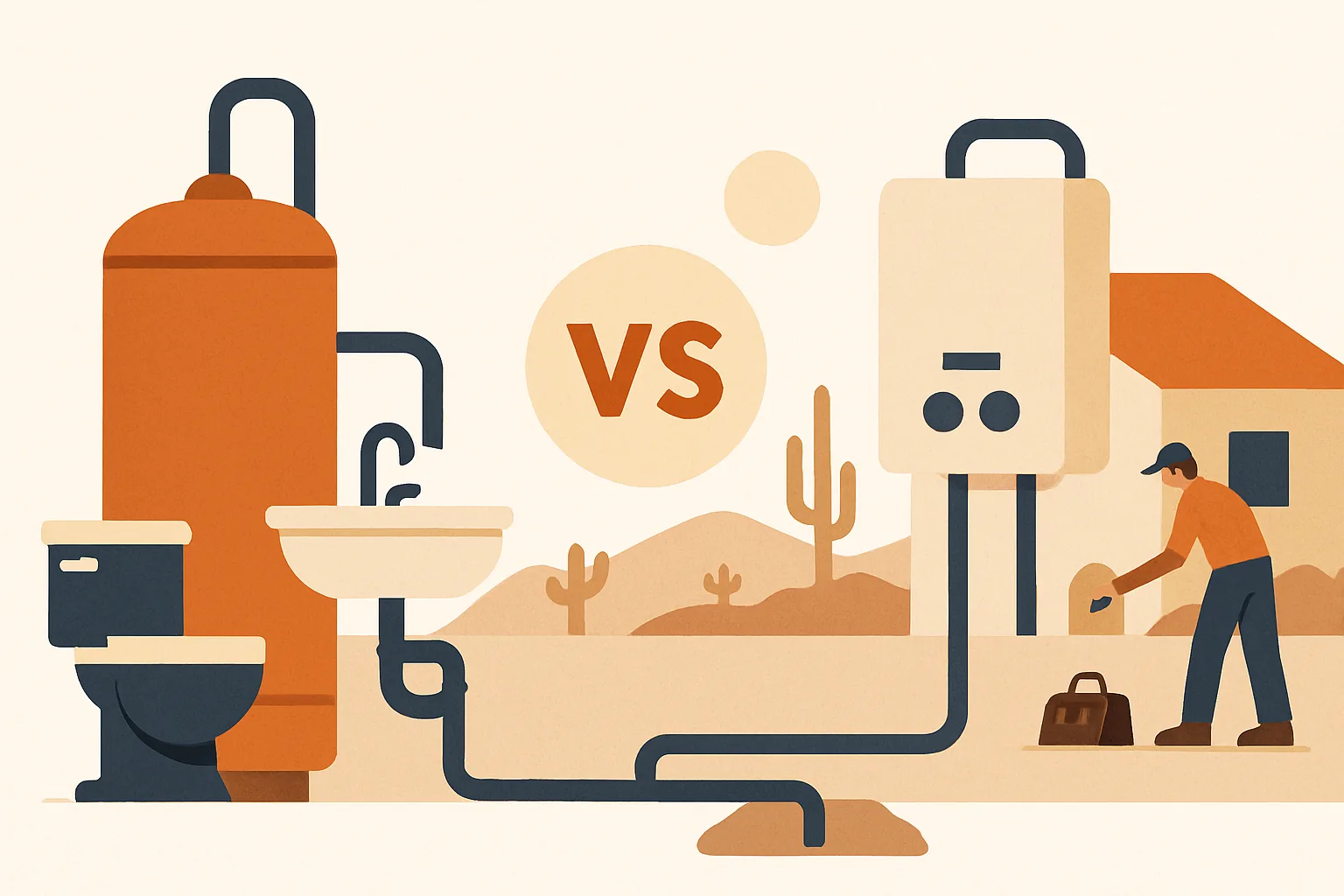
Las Vegas has very hard water and long hot summers, which affect how both tank and tankless water heaters age and perform. Here is how a whole-home plumbing inspection helps you decide which system fits your home, budget, and long-term plans.
How does Las Vegas water change the tank vs tankless decision?
The starting point for any water heater decision in Las Vegas is the water itself. The Las Vegas Valley Water District reports that valley water is about 280 parts per million, or roughly 16 grains per gallon, which is classified as very hard water. Hard water carries a lot of dissolved minerals that settle out as scale when the water is heated. That mineral scale collects on heating elements, tank bottoms, and inside small passages in water heater heat exchangers.
For a traditional tank-style water heater, mineral scale tends to accumulate on the bottom of the tank and on the heating elements. Over time this can reduce efficiency, increase heating time, create popping or rumbling noises, and shorten the life of the tank. For tankless units the risk is different. Scale can build up inside the narrow passages of the heat exchanger and small internal parts, which can trigger error codes, reduce flow, or stop the unit from firing at all. Very hard water makes regular inspections and descaling much more important no matter which heater type you choose.
This is where a whole-home plumbing inspection becomes useful before you decide on tank vs tankless. During an inspection, a licensed plumber can evaluate your current heater for signs of severe scale buildup, check your water pressure, and note whether you already have a water softener or filtration. They can also estimate how quickly a new tank or tankless unit in your home is likely to accumulate scale under real Las Vegas conditions. That means you are choosing between options with a realistic picture of how often each one will need professional service.
- Las Vegas water is classified as very hard at about 16 grains per gallon.
- Hard water speeds up scale buildup in both tank and tankless heaters.
- Scale reduces efficiency and can shorten water heater life.
- An inspection can reveal current scale levels and softening equipment.
- Understanding hardness impact helps you plan realistic maintenance.
When does a traditional tank water heater make more sense in Las Vegas?
Even with very hard water, tank-style water heaters are still a strong choice in many Las Vegas homes. The biggest advantage is upfront cost. According to cost ranges reported by Angi and HomeAdvisor, homeowners usually spend a few hundred dollars for inspection work, while actual water heater install pricing ranges widely and depends on capacity, fuel type, and site conditions. In general, tank units have lower equipment cost and simpler venting, so the overall project cost tends to be less than a comparable tankless system when everything else is equal.
During a whole-home plumbing inspection, a plumber looks at your existing tank, the gas or electrical supply, venting route, drain pan and drain line, and nearby shutoff valves. InterNACHI standards and checklists like those compiled by FieldScribe emphasize verifying the water heater’s safety devices, such as the temperature and pressure relief valve and discharge piping. If the inspector finds that your current tank is installed reasonably well and your hot water usage is moderate, replacing it with another tank of the correct size may be the most cost-effective path.
Tank heaters also handle certain usage patterns better. If your household tends to use a lot of hot water at once, such as multiple showers, running laundry, and the dishwasher together, a properly sized tank can deliver a predictable amount of stored hot water without being limited by burner size or instantaneous flow. For some Las Vegas homes with older electrical service or limited gas line capacity, a tank heater may simply fit the existing infrastructure better. An inspection will uncover whether your current lines, venting, and space can support an upgrade or if staying with a tank is the smarter investment right now.
- Lower upfront equipment cost compared to most tankless units.
- Simpler venting and fewer changes to existing connections.
- Better fit for homes that use a lot of hot water at the same time.
- Often works well with older gas or electrical service capacities.
When does a tankless water heater win in a Las Vegas home?
Tankless water heaters offer several advantages that can be especially attractive in Las Vegas, provided that your home is set up to support one. The main selling points are on-demand hot water, space savings, and potential energy savings because the unit is not keeping a full tank of water hot all day. For households that are out of the home for long stretches or for smaller families that do not use as much hot water at once, a properly sized tankless heater can be a very efficient option.
However, very hard water changes how you plan for a tankless install. Because scale can clog the tight passages in a tankless heat exchanger, manufacturers typically recommend regular descaling or flushing in hard water areas. A whole-home plumbing inspection can confirm incoming water hardness, check for an existing water softener, and evaluate whether adding softening or filtration would be wise before you invest in a tankless unit. The inspector will also examine gas line sizes, electrical circuits, wall space, and venting routes to see whether a tankless unit can be installed safely and to code.
Homeowners sometimes expect tankless water heaters to deliver unlimited hot water under any condition. In practice, a tankless unit is limited by its maximum flow rate at a given temperature rise. Incoming water temperature in Las Vegas is warmer in summer than in winter, which helps, but a whole-home plumbing inspection lets a plumber calculate realistic flow rates for your fixtures and habits. They can compare that to manufacturer specifications and advise whether one tankless unit can handle your home or if multiple units or a hybrid solution would better match your peak demand.
- Tankless units save floor space and can mount on a wall.
- On-demand heating can reduce standby energy use.
- They work well for smaller households with staggered hot water use.
- Inspections confirm if gas, power, and venting support a tankless upgrade.
What will a whole-home plumbing inspection check before you switch water heater types?
Before you decide to stay with a tank or move to a tankless heater, it pays to understand what a thorough whole-home plumbing inspection includes. Cost guides from Angi and HomeAdvisor report that a full plumbing inspection usually runs from about $100 to $500, with more detailed inspections that use cameras or advanced tools reaching up to $1,375 depending on the property. HomeAdvisor also notes that most full plumbing inspections take around 2-3 hours for a typical home, which is enough time for a trained eye to walk the full system and document issues.
Checklists like the ones used by inspectors and platforms such as FieldScribe show that a proper inspection covers both the water supply side and the drain, waste, and vent side. For water heater planning, your plumber will inspect the main shutoff, measure water pressure, identify piping materials, and examine all fixtures for flow issues that might hint at hidden corrosion or scale. They will closely review your current water heater, including the tank or heat exchanger, venting, flue connections, combustion air, electrical connections, and the temperature and pressure relief valve routing.
On the drain side, they will check for correct traps, slope, and venting, since drainage issues can affect how safely and conveniently a new heater can be tied into existing lines. Common problems that often show up in inspections include high water pressure without a pressure reducing valve, older and less reliable piping materials, incorrect discharge routing for relief valves, and corrosion or leaks around shutoffs. Discovering these issues now helps you budget more accurately for a tank or tankless replacement and reduces surprise change orders on installation day.
- Inspectors review the entire supply and drain system, not just the heater.
- They measure water pressure and note if a pressure reducing valve is installed.
- They inspect the current heater, venting, and safety devices in detail.
- They look for leaks, corrosion, and outdated or risky materials.
- They document code or safety issues that affect replacement options.
How should a Las Vegas homeowner compare lifetime costs and maintenance for tank vs tankless?
To make a fair choice between tank and tankless water heaters, you need to think beyond the sticker price. In Las Vegas, very hard water makes maintenance a bigger slice of the lifetime cost for any heater. Scale that collects in a tank may be managed with periodic flushing and inspection. In a tankless heater, scale control is even more critical and might involve annual or biannual descaling, especially if there is no water softener. A whole-home plumbing inspection allows your plumber to see how quickly scale has built up in your current system, which is a good clue about future maintenance frequency.
Energy usage is another part of lifetime cost. Tank units keep a reservoir of water hot, which can waste energy during idle periods. Tankless units avoid that standby use but may have higher initial costs and, in some homes, require upgrades to gas piping or electrical circuits. Inspection findings about your existing infrastructure can show whether the extra work needed for tankless would pay for itself in realistic timeframes for your household. They can also reveal whether a water softener should be included in your plan to protect a new system in very hard water.
Finally, you will want to consider reliability and how you prefer to handle risk. Tank heaters usually fail in a more predictable pattern with visible corrosion, reduced hot water supply, or small leaks that a regular inspection can catch before a tank rupture. Tankless units tend to hold their efficiency longer but may be more sensitive to neglected maintenance or power issues. When a plumber performs a whole-home plumbing inspection, you can talk through these tradeoffs using your actual plumbing layout, your family’s schedule, and your risk tolerance rather than general claims from product marketing.
- Factor in maintenance like flushing or descaling when comparing lifetime cost.
- Use inspection findings about scale to estimate future service frequency.
- Include any needed gas or electrical upgrades in your budget comparison.
- Discuss how your family’s schedule affects potential energy savings.
- Balance initial cost, ongoing bills, and your comfort with different failure risks.
- undefined
- undefined
- undefined
- undefined
- undefined
- undefined
- undefined
- undefined
- undefined
Frequently asked questions
- Is a tank or tankless water heater better for Las Vegas hard water?
- Neither type is automatically better in very hard water, but each needs the right maintenance plan. The Las Vegas Valley Water District classifies local water as very hard at about 16 grains per gallon, which increases scale buildup in both tank and tankless units. A whole-home plumbing inspection lets a licensed plumber see how hard water is affecting your current system and recommend flushing, descaling, or softening so either option can last longer.
- How does a whole-home plumbing inspection help me choose between tank and tankless?
- A whole-home plumbing inspection gives you data about your existing heater, piping, venting, water pressure, and water hardness instead of guessing. According to cost guides from Angi and HomeAdvisor, inspections typically cost between about $100 and $500 for most homes, which is a small investment compared with a full heater replacement. With those findings, a plumber can tell you which type fits your home’s infrastructure, hot water demand, and long-term budget best.
- Do tankless water heaters really save money in Las Vegas?
- Tankless water heaters can reduce standby energy use because they do not keep a tank of water hot all day, which often leads to lower energy bills for some households. However, they usually cost more to install and may require gas or electrical upgrades that a tank unit would not. A whole-home plumbing inspection can reveal whether your home can support a tankless unit without major changes and help you decide if the long-term savings justify the higher upfront cost.
- How often should my water heater be checked in Las Vegas hard water conditions?
- With very hard water, it is wise to have your water heater checked at least once a year as part of a whole-home plumbing inspection. Field inspection checklists highlight that inspectors often find scale, corrosion, high pressure, and incorrect relief valve routing, all of which can shorten heater life. Regular inspections allow a plumber to flush or descale your system and catch small issues before they turn into leaks or failure.
- Can my existing gas line and venting handle a tankless water heater?
- Not every existing gas line or venting setup can support a tankless unit, especially in older homes or those with smaller gas piping. During a whole-home plumbing inspection, the plumber will measure pipe sizes, review vent routes, and compare them to typical tankless requirements. If upgrades are needed, they can include those in your estimates so you can compare the real-world cost of tank vs tankless for your specific home.
- What does a plumber look at during a water heater inspection in Las Vegas?
- During a water heater portion of a whole-home plumbing inspection, the plumber examines the tank or heater body, venting, gas or electrical connections, shutoff valves, and the temperature and pressure relief valve and discharge piping. Inspection standards, including those from InterNACHI and detailed checklists from FieldScribe, also emphasize checking for leaks, corrosion, high water pressure, and unsafe materials. In Las Vegas, they will also pay close attention to scale buildup related to very hard water so they can recommend appropriate maintenance or replacement options.
Talk to Kingdom Plumbing about whole-home plumbing inspection, or call (702) 840-5037. Family-owned, NV Contractors License #0085422, upfront flat-rate pricing.
Kingdom Plumbing is a family-owned, licensed Las Vegas plumber (NV NV Contractors License #0085422) serving the valley since 2018. Questions about how this affects your home? Call (702) 840-5037. Dealing with a burst pipe or flooding right now? Our emergency plumbers in Las Vegas answer 24/7.