
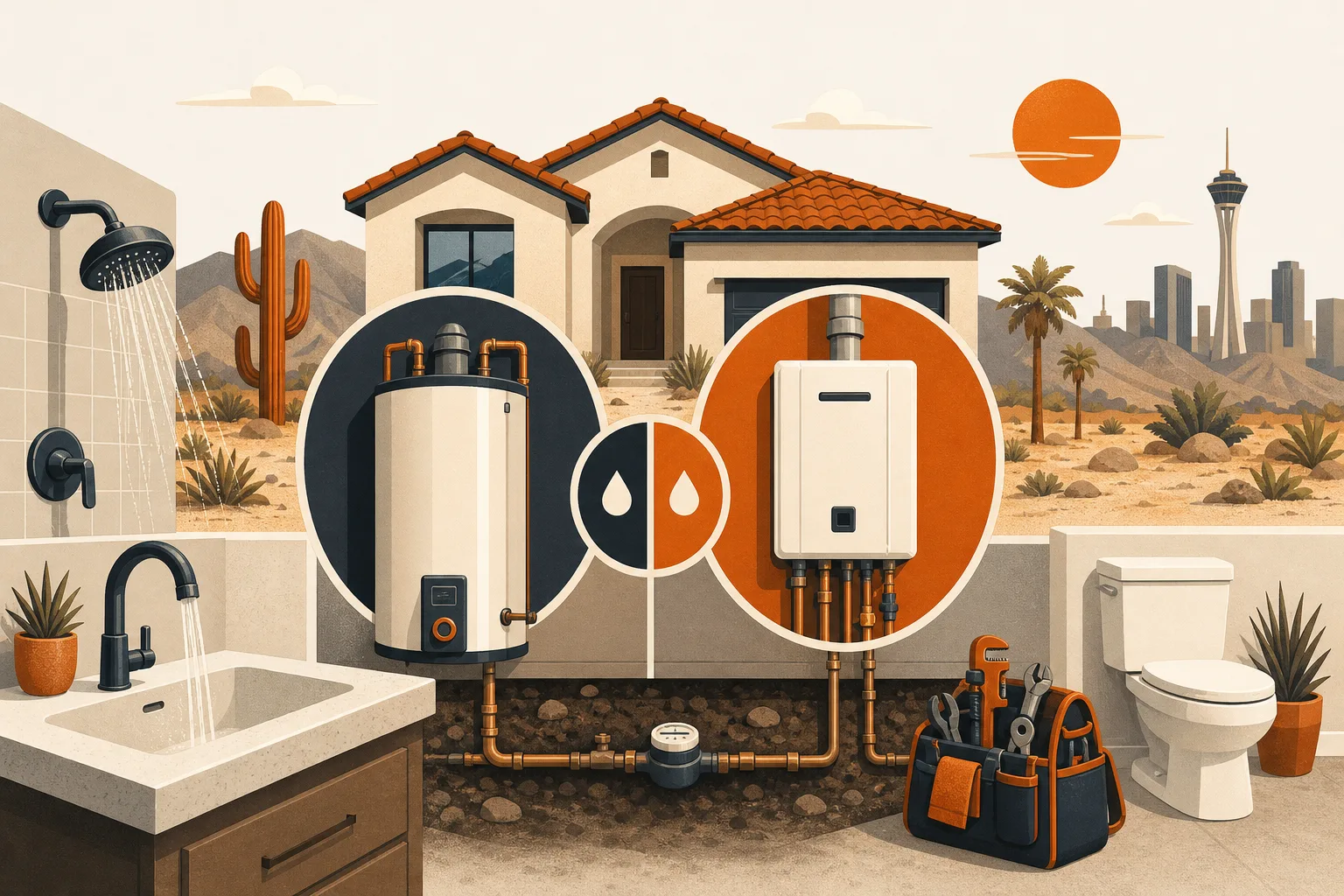
Las Vegas homes face very hard water and extreme temperatures, which change how both tank and tankless water heaters age and perform. This guide explains when each type actually makes sense in the valley and how to decide before you invest in water heater repair and replacement.
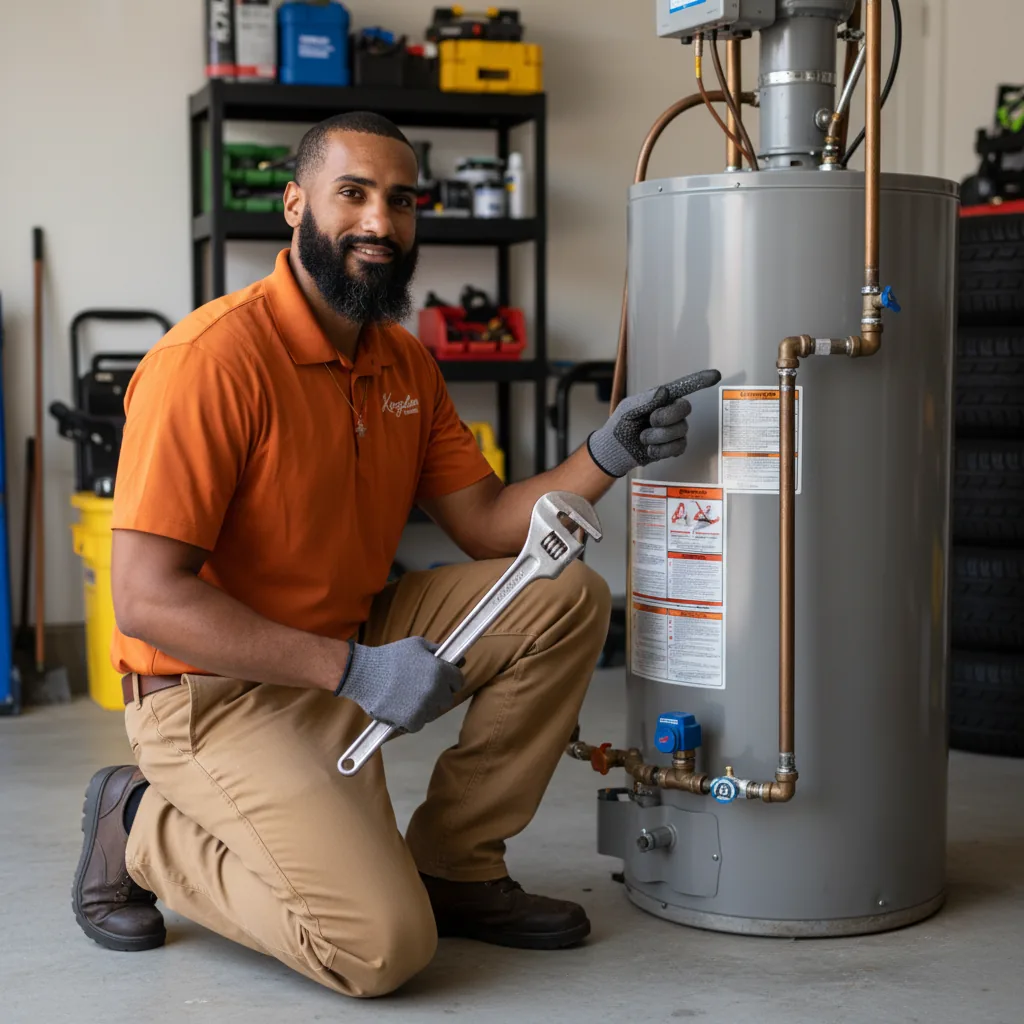
How Las Vegas water and homes change the tank vs tankless decision
In many national guides, the tank versus tankless debate is treated like a simple math problem about energy savings over time. In Las Vegas, that picture changes because of our water and our construction. The Las Vegas Valley Water District reports valley water hardness around 291 parts per million, or roughly 17 grains per gallon, which is in the “very hard” category. That much mineral content means any water heater in the valley is fighting scale from the day it is installed.
Nationally, manufacturers often quote an 8 to 12 year life for a standard tank water heater. In Kingdom Plumbing’s day-to-day work across the valley, we regularly see tanks that are closer to 5 years old already showing advanced wear from scale and sediment in our very hard water. Tankless units are affected too, just in different ways, as minerals build up inside the heat exchanger and small passages. Add in our slab-on-grade homes with water heaters in tight garages or closets, and the local reality is that installation details, drainage, and code upgrades matter just as much as brand or efficiency rating when you compare tank and tankless.
Because of this, the right choice is not about chasing a perfect national payback chart. It is about what fits your home’s plumbing layout, your family’s hot water habits, and how often you are willing to maintain the system so scale does not cut its life even shorter. A well-installed tank with regular flushing can be the smarter bet in some Las Vegas homes, while a properly sized and descaled tankless system can be the better long-term solution in others. The rest of this guide walks through how to sort those scenarios out before you commit to water heater repair and replacement.
- Very hard water in Las Vegas accelerates scale in any water heater.
- Local heater lifespan is often shorter than national estimates.
- Slab-on-grade homes limit drain and vent options for replacements.
- Code upgrades under the 2024 Uniform Plumbing Code affect both types.
What a standard tank water heater does well in Las Vegas (and where it struggles)
A traditional tank water heater stores 30 to 75 gallons of hot water and keeps it ready around the clock. In Las Vegas, many homes still rely on these units because they are familiar, their replacement is relatively straightforward, and they do not usually require major gas line or electrical changes. For a typical slab-on-grade house with an existing gas or electric tank and nearby drain, a like-for-like tank swap can often be completed in roughly 2 to 4 hours in accessible locations, based on industry timing guides for the valley. That shorter work window reduces disruption and can be important if you are already without hot water.
Tanks also tend to be easier to service when something goes wrong. Common repairs like thermostats, gas controls, or electric elements are accessible, and routine maintenance such as flushing sediment is well-understood. In very hard Las Vegas water, regular flushing becomes less of a nice-to-have and more of a survival tool for the tank. Sediment at the bottom can insulate the water from the burner or elements, which leads to hot and cold swings, popping noises, and eventually leaks. Since valley tanks often show their age around 5 years in real use, it usually makes sense to weigh the cost of any major repair against the price of a full replacement at that point.
The downside of a tank is running out of hot water. If several showers, a dishwasher cycle, and a washing machine hit the tank back-to-back, you can drain the stored hot water and wait for the tank to recover. In hot Las Vegas summers, the incoming water is warmer, which helps recovery a bit, but scale on the heating surface still slows things down. Tanks also take up more floor space than a wall-hung tankless unit and continuously keep water hot, which uses more energy than only heating water on demand. For some families, that trade-off is acceptable for the simpler install, but it is important to be honest about how much hot water you use in the busiest hour of your day.
- Best for families with moderate, predictable hot water use.
- Easier and faster to replace in most existing Las Vegas homes.
- Requires regular flushing to fight sediment from very hard water.
- Can run out of hot water during back-to-back showers or laundry.
Where a tankless water heater wins for Las Vegas households
Tankless water heaters heat water as it flows through the unit instead of storing a large volume. The main attraction in Las Vegas is effectively “endless” hot water for long showers or large families, as long as the system is sized and installed correctly. For busy homes that shower, wash dishes, and run laundry at the same time, a properly chosen tankless can avoid the cold-shower surprise that comes with an undersized tank. You also gain back some floor space, which can matter in tight garages or closets that already house softeners, filtration, or storage.
Tankless units are typically more efficient than standard tanks because they are not reheating the same water all day and night. Over time, that efficiency can help offset the higher upfront cost of the system and installation. In Las Vegas, though, that long-term benefit only holds if hard water is kept under control. The 17 grain per gallon water reported by the Las Vegas Valley Water District has a lot of calcium and magnesium, which can quickly scale the narrow passages and heat exchanger inside a tankless unit. Descaling and flushing are not optional here, they are critical maintenance tasks to keep performance and efficiency where they should be.
Installations are often more involved than a simple tank swap. Depending on your home, a tankless conversion may require new venting, upsized gas lines or electrical circuits, and changes to how the system drains. Industry guidance for the valley notes that these more complex jobs routinely take 4 to 8 hours and may also trigger add-ons like expansion control and code-related updates. This does not mean a tankless system is a bad idea, it just means it needs a thorough on-site evaluation and a realistic budget. When everything is sized and installed correctly, a tankless heater can be a great fit for Las Vegas families that hate waiting for hot water and plan to stay in the home long enough to benefit from efficiency gains.
- Ideal for large families or heavy back-to-back hot water use.
- Saves floor space compared to a full-size tank in a garage or closet.
- Needs regular descaling to handle Las Vegas hard water.
- Often requires more installation time, venting, and gas or electrical upgrades.
Costs, timelines, and code work: what to expect for each type
When you compare tank and tankless, it helps to understand what drives costs and timelines in Las Vegas instead of just focusing on the water heater itself. For a tank replacement, Kingdom Plumbing’s flat-rate planning range in the Las Vegas valley runs from $3,100 to $3,600 for many common residential setups, with all tank sizes ranging from $2,800 to $8,700 when installations become more complex. That flat-rate structure means you see the total number up front, approve it before work starts, and are not surprised by hourly add-ons once the job is underway. Tanks also usually reuse existing gas or electric service and shorter vent runs, which keeps labor contained.
Tankless water heater installation typically carries a higher upfront investment. Kingdom Plumbing’s tankless water heater installation planning range is $7,900 to $9,900, or $5,600 to $6,300 if you already have a suitable customer-supplied unit and the home is a good candidate. Those ranges reflect the more technical setup, including venting, possible gas line or electrical upgrades, and careful commissioning. A tankless conversion often requires additional work for drainage, such as routing condensate and ensuring the temperature and pressure relief line has an appropriate termination, especially with water heaters installed over living spaces or in finished areas.
Both tank and tankless replacements in Las Vegas are now performed under the 2024 Uniform Plumbing Code with Southern Nevada Amendments. That means a compliant job involves seismic strapping, an accessible gas shutoff ahead of the connector for gas units, a sediment trap, a properly run temperature and pressure relief line that does not discharge into an attic pan, and electrical bonding where required. In garages, gas water heaters need to be elevated or otherwise protected from vehicle impact. Each of these pieces adds a bit of labor and material cost, but they are there to protect your home, and inspectors in Clark County and the City of Las Vegas expect to see them when they sign off on a water heater permit.
How to decide: which homes are better for tank and which for tankless in Las Vegas
With Las Vegas-specific factors on the table, a pattern starts to emerge for when each option usually makes more sense. A standard tank is often the better match if you have a smaller household, a tighter upfront budget, and existing gas or electric service that fits a modern tank without major modification. It also fits well when the heater location is cramped or venting routes are limited, such as in some townhomes or older slab-on-grade houses where routing new vent or condensate lines would require cutting finished surfaces. In these homes, investing in a quality tank, regular flushing, and any needed water treatment is often the most practical route.
A tankless system tends to be the better candidate when several conditions line up. If your family regularly runs multiple showers, a dishwasher, and laundry close together, the demand pattern favors the on-demand design. Homes with easier access for venting and gas line adjustments, or new construction and major remodels, are particularly good opportunities to do tankless right. Long-term owners who plan to stay put and care about squeezing more efficiency from every gallon of hot water are also more likely to reap the benefits. In these cases, committing to consistent descaling and maintenance becomes part of the ownership plan rather than an afterthought.
Whichever direction you lean, it pays to approach water heater repair and replacement as a whole-system decision. That means looking at your water hardness, whether you have or plan to add a softener, how the hot and cold lines are routed in the home, and what local code expects for drainage and safety. Having a licensed, bonded, and insured plumber who works under the 2024 local code walk the space with you can uncover constraints and opportunities that are not obvious from online research. Kingdom Plumbing has seen many Las Vegas homes where a well-thought-out tank is the best balance and others where a properly sized tankless unlocks comfort the family never had before.
- Count how many showers, faucets, and major appliances regularly use hot water at the same time in your Las Vegas home so you can estimate your true peak demand.
- Check the age and condition of your current water heater by reading the data plate, and if it is around 5 years or older in this valley, expect shorter remaining life than national charts suggest.
- Look at where your current heater sits and note how much space, venting, electrical, and gas line access you actually have, since this can make or break a tankless upgrade.
- Confirm whether you already have a water softener or plan to add one, because that choice affects maintenance schedules for both tank and tankless systems in very hard water.
- Set a realistic budget range for water heater repair and replacement, including potential permit, thermal expansion, and code upgrade items that may be required under local rules.
- Decide how long you plan to stay in the home, because a longer timeline makes it easier to justify the higher upfront cost of a tankless system and its efficiency benefits.
- List any recurring issues you have now, such as lukewarm showers, long waits for hot water, or frequent sediment noises, so your plumber can match a solution to those specific problems.
- Schedule a diagnostic visit with a licensed Nevada plumber, such as Kingdom Plumbing, to evaluate your existing setup, explain tank versus tankless options on-site, and provide flat-rate planning ranges before work begins.
Frequently asked questions
- Is a tankless water heater really worth it in Las Vegas hard water?
- A tankless water heater can absolutely be worth it in Las Vegas if it is sized correctly and maintained for scale. Our very hard water, about 16 to 17 grains per gallon according to the Las Vegas Valley Water District, means tankless units must be flushed and descaled on a regular schedule. If you are committed to that maintenance and want continuous hot water and better efficiency, tankless can be a smart long-term choice.
- How long should a water heater last in Las Vegas compared to other places?
- Nationally, manufacturers often suggest that a standard tank water heater will last about 8 to 12 years. In the Las Vegas valley, Kingdom Plumbing commonly finds that real-world lifespans run closer to 5 years because very hard water causes accelerated scale and wear. Tankless systems can last longer with proper descaling, but they are still affected by mineral buildup if maintenance is skipped.
- Does a tankless water heater save money on my Las Vegas power or gas bill?
- Tankless water heaters are generally more efficient because they heat water only when you need it, rather than reheating a stored tank all day. Over time, that can lower energy use compared with a standard tank, especially in larger households with heavy hot water demand. In Las Vegas, the hard water means you only get those benefits if you keep the unit descaled so the heat exchanger can transfer heat efficiently.
- How long does it take to replace a water heater in Las Vegas?
- For a straightforward like-for-like tank water heater replacement in an accessible location in Las Vegas, industry guides put the work at about 2 to 4 hours, including removal, installation, and testing. A conversion to tankless or a job that needs gas, electrical, or venting changes typically runs 4 to 8 hours. Local permits and inspections can add several business days to the overall project timeline for final sign-off.
- What code requirements should I expect for a new water heater in Las Vegas?
- Clark County and the City of Las Vegas have adopted the 2024 Uniform Plumbing Code with Southern Nevada Amendments, which sets the rules for new water heater installations. You can expect requirements such as seismic strapping, an accessible gas shutoff and sediment trap for gas units, proper electrical bonding, and a temperature and pressure relief line that terminates safely and not into an attic pan. In garages, gas units usually must be elevated or otherwise protected from vehicle impact.
- How do I know if I should repair or replace my existing tank water heater?
- In Las Vegas, if your tank is around 5 years old or more and showing signs such as rust, leaks, or frequent breakdowns, replacement often makes more sense than repeated repairs. When a repair estimate climbs close to what a new unit would cost, it is usually better value to put that money toward a modern, more efficient heater. A licensed plumber can inspect the tank, check for scale buildup and safety concerns, and walk you through both repair and replacement options.
Talk to Kingdom Plumbing about water heater repair and replacement, or call (702) 840-5037. Family-owned, NV Contractors License #0085422, upfront flat-rate pricing.
Kingdom Plumbing is a family-owned, licensed Las Vegas plumber (NV NV Contractors License #0085422) serving the valley since 2018. Questions about how this affects your home? Call (702) 840-5037. Dealing with a burst pipe or flooding right now? Our emergency plumbers in Las Vegas answer 24/7.