
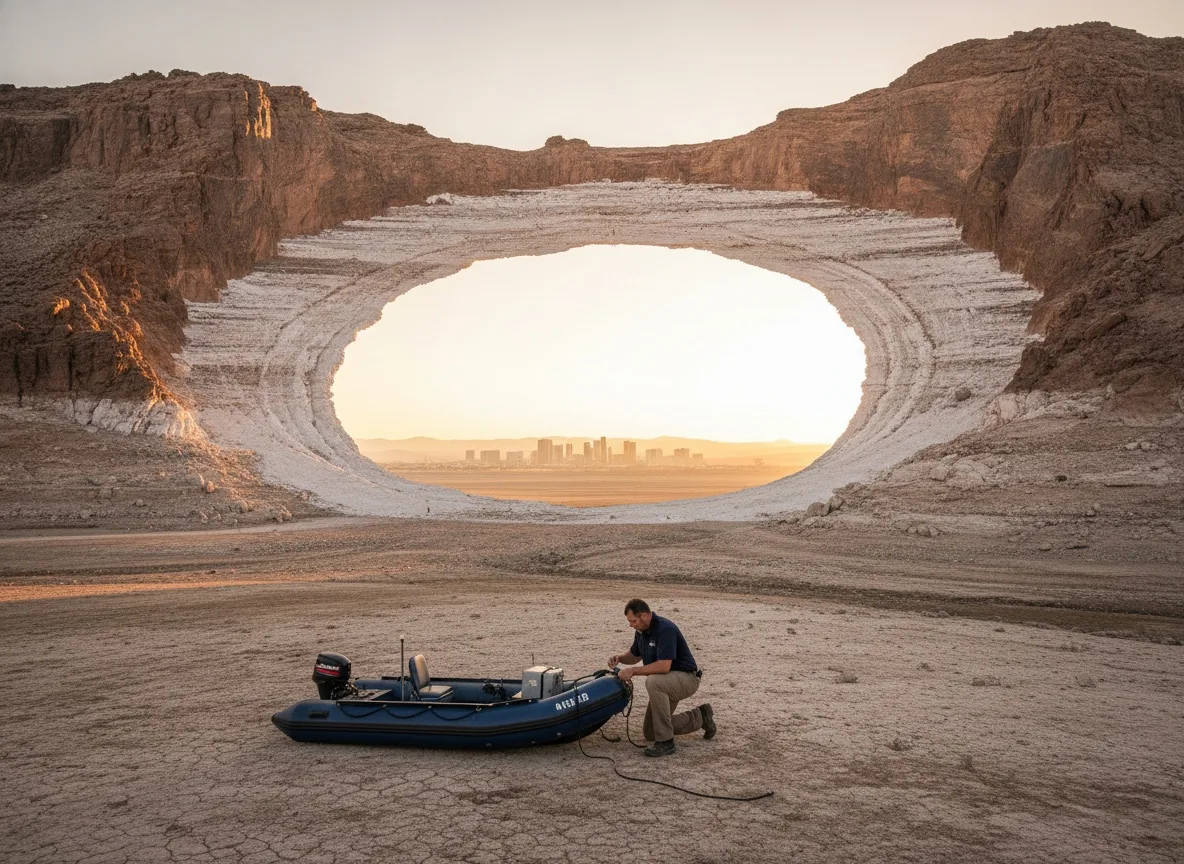
The Metropolitan Water District of Southern California will leave up to 200,000 acre-feet of its own Colorado River water in Lake Mead this year in exchange for federal payments. Here is why Southern Nevada's water supply and Hoover Dam power both stand to benefit, and what a Las Vegas homeowner should still do about it.
Why a California Agency Is Paying to Not Use Its Own Water
Metropolitan Water District, which supplies roughly 19 million people across Southern California, holds some of the oldest and largest rights to Colorado River water in the entire basin. Its board approved an agreement in July 2026 that lets it collect federal money for leaving water in Lake Mead instead of drawing its full allocation this year.
Under the deal, the Bureau of Reclamation will pay Metropolitan $325 for every acre-foot it keeps in the reservoir, capped at 200,000 acre-feet and roughly $65 million total. The money comes from a conservation and efficiency program funded through the 2022 Inflation Reduction Act. Metropolitan's board chair framed it as a payoff from decades of conservation spending that gave the agency more water than it currently needs to use.
Two smaller side agreements add to the total. The Quechan Tribe and Bard Water District, both along the lower river near the California-Arizona border, will send up to 19,000 acre-feet of conserved farm water into the lake in 2027 and 2028.
How Much Difference This Actually Makes at Lake Mead
Reclamation officials expect Metropolitan's contribution alone to add about three feet to Lake Mead's elevation by the end of the year. Taken together with similar arrangements already underway in Arizona and Nevada, officials are projecting close to 700,000 acre-feet of combined conservation and roughly 10 feet of elevation gain over time.
That matters because the lake was sitting near 1,043 feet in mid-July 2026, just a couple of feet above the record low it set in 2022, with forecasters warning a new record could arrive within weeks. A Metropolitan general manager was blunt about the limits of the deal, telling reporters it will buy time rather than fix the underlying supply and demand gap on the river.
The stakes go beyond drinking water. If Lake Mead keeps falling toward the elevation where Hoover Dam's turbines struggle to operate, the dam's hydropower output could eventually drop by a large share, a separate concern from tap water but one tied to the same shrinking reservoir that feeds Southern Nevada.
What This Does, and Does Not, Change for Southern Nevada
This deal does not touch the Southern Nevada Water Authority's own conservation rules. The mandatory summer watering schedule, the ban on new nonfunctional turf, and the shortage tier that already governs Nevada's own Colorado River allocation all stay exactly as they were before this announcement.
What it does offer is a bit of short term breathing room while the seven basin states keep negotiating the long-term operating rules due to replace the current guidelines at the end of 2026. For a Las Vegas homeowner, the practical takeaway has not changed: Nevada's supply security still depends far more on what happens inside the meter at home than on any single upstream deal.
- Lake Mead's Low Lake Level Pumping Station already secures Las Vegas access to water even if the lake keeps dropping
- Deals like this one are temporary bridges, not a fix for the river's long-term supply and demand gap
- Southern Nevada's own watering schedule and turf rules remain unchanged by this agreement
- The most reliable water savings still come from fixtures, irrigation habits, and leaks inside a home
What a Las Vegas Homeowner Should Actually Do With This News
Treat this deal as a reminder rather than a reason to relax. A few feet of elevation gain at Lake Mead is genuinely useful for water security and Hoover Dam power, but it does not erase the underlying math of a river system that has less water than the region built its allocations around decades ago.
The highest value moves for a household are the same ones Kingdom Plumbing has been recommending all summer: fix running toilets and dripping fixtures promptly, keep irrigation timers matched to the current SNWA watering schedule, and have a licensed plumber check for slow leaks that waste water without ever showing up as a puddle. If your water bill has crept up without an obvious reason, that is worth a look before the next round of Colorado River news arrives.
Figures reported from the Bureau of Reclamation and Metropolitan Water District of Southern California agreements, July 2026.
5 Things To Know About the Lake Mead Conservation Deal
The headline numbers are large, but here is what actually matters for a Southern Nevada household.
- It is a payment, not a pipeline: Metropolitan is being paid to leave water it already has rights to in the lake, not to build new infrastructure.
- The money comes from federal conservation funds: Reclamation is drawing on a program funded through the 2022 Inflation Reduction Act rather than new congressional appropriations.
- It is temporary by design: The agreement covers 2026, with the tribal and Bard Water District pieces extending into 2027 and 2028.
- Nevada's own rules are untouched: SNWA's watering schedule, turf ban, and shortage tier already existed and do not change because of this deal.
- Hoover Dam power is part of the calculation: Keeping the lake higher helps protect hydropower generation that serves the wider Southwest, including Southern Nevada.
Frequently asked questions
- Does this mean Las Vegas water restrictions could be lifted soon?
- No. This deal involves a California agency's own Colorado River allocation and does not change Nevada's shortage tier or its existing watering rules.
- Why would California pay to leave water it is allowed to use?
- Metropolitan Water District has more banked conservation and infrastructure capacity than it needs to use its full allocation this year, so the federal payment is more valuable to it than the water itself right now.
- How much could this actually raise Lake Mead's level?
- Reclamation estimates roughly three feet from Metropolitan's piece by year end, with the full set of similar deals across three states projected to add about ten feet over the longer term.
- Should I change anything about my home's water use because of this?
- No, keep following SNWA's existing watering schedule and treat the deal as one more sign that regional supply stays tight. If you want a plumbing check for hidden leaks or aging fixtures, call Kingdom Plumbing at (702) 840-5037.
Kingdom Plumbing is a family-owned, licensed Las Vegas plumber (NV NV Contractors License #0085422) serving the valley since 2018. Questions about how this affects your home? Call (702) 840-5037. Dealing with a burst pipe or flooding right now? Our emergency plumbers in Las Vegas answer 24/7.
More Updates
- Nevada's Senators Want Extreme Heat Treated Like a Disaster for Water Systems: What It Means for Your Pipes
- A New Multibillion Dollar Pipeline Is Coming to Southern Nevada: What the Horizon Lateral Means for Henderson Homeowners
- Lake Mead and Lake Powell Just Hit Their Lowest Combined Level Since Before the Dam Was Built: What It Means for Your Las Vegas Home
- Lake Powell Just Slid Toward a New Low: What a Struggling Upstream Reservoir Means for Your Las Vegas Water and Power