
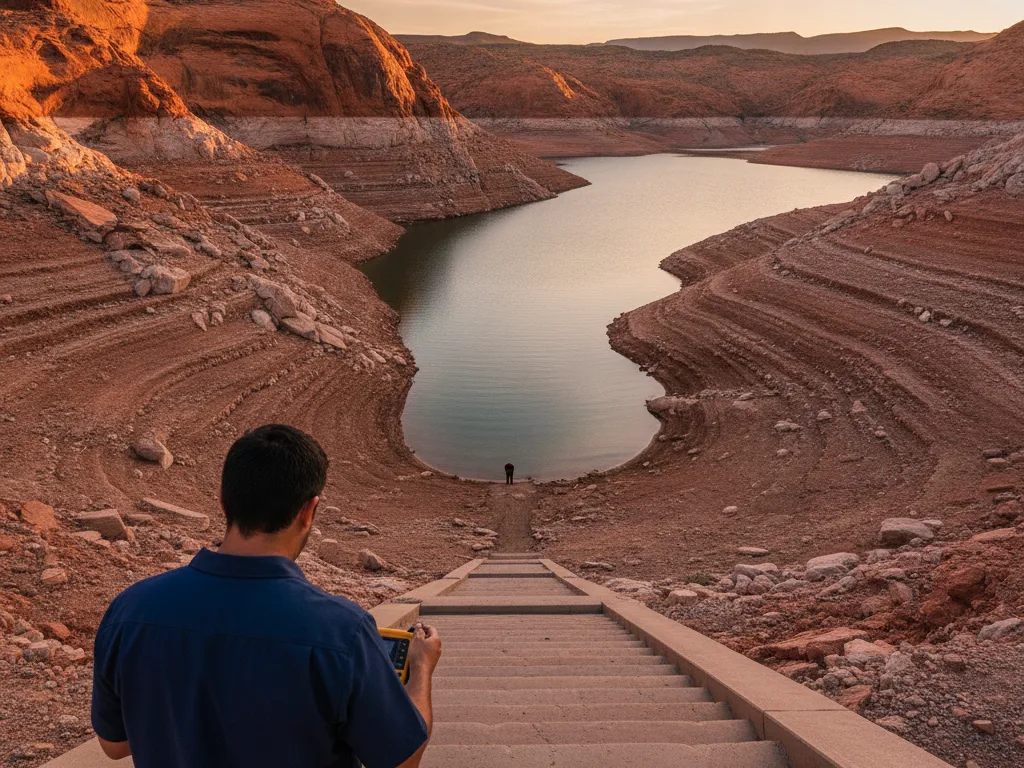
Lake Powell, the reservoir that feeds Lake Mead, is sitting only a few feet above its 2023 record low this month, and researchers say new record territory is close. Here is what that means for a Las Vegas home, and what to check indoors while the Colorado River system stays stretched thin.
Lake Powell's Numbers This Month
Lake Powell, the reservoir held back by Glen Canyon Dam on the Arizona-Utah border, is measuring roughly 3,524 feet of elevation this month. That places it barely above the all-time low of 3,522 feet set in April 2023, and reservoir watchers now describe the gap as a matter of feet rather than years. The lake sits at less than a quarter of its total capacity, a level that would have seemed unthinkable when the dam was completed decades ago.
Jack Schmidt, who heads Utah State University's river research center focused on the Colorado, put it plainly this month: "We will soon be in record-breaking territory." Federal managers have leaned on short-term emergency releases from upstream reservoirs to slow the bleeding, but those moves buy time rather than reverse the trend. Powell's storage keeps sliding even with that help.
Two thresholds matter here. Around 3,490 feet, the dam's minimum power pool, the turbines can no longer reliably generate electricity. Below roughly 3,370 feet, often called dead pool, water can no longer pass through the dam under gravity at all. Powell currently sits about 34 feet above the power threshold, a cushion that has been shrinking year over year rather than growing.
Why an Upstream Reservoir Shows Up in a Las Vegas House
Lake Powell does not supply Las Vegas water directly. It sits upstream, and its releases refill Lake Mead, the reservoir Southern Nevada actually draws from. When Powell runs low, federal operators face pressure to hold back water rather than send it downstream, which tightens the very supply Lake Mead depends on. That is a separate mechanical squeeze from the Colorado River allocation cuts Nevada already absorbs, and it compounds the pressure on a river system that was already stretched before this summer's heat.
The Glen Canyon powerplant has eight generating units with a combined capacity of about 1,320,000 kilowatts, and every foot Powell drops reduces the hydraulic head that pushes water through those turbines, cutting efficiency even before the dam hits its formal minimum power threshold. Reporting this month notes that emergency measures aimed at propping up Powell could accelerate declines at Lake Mead in turn, with estimates of up to a 40 percent cut to Hoover Dam's hydropower generating capacity possible as early as this fall.
None of that means a Las Vegas tap will run dry tomorrow. It does mean the region's power mix loses a slice of low-cost hydroelectric generation right as electricity demand peaks from summer air conditioning, and it means the pressure to conserve water at the household level is not going away once this heat wave passes.
What To Check Indoors While the River Stays Tight
A homeowner cannot fix a reservoir four states away, but a surprising amount of household water and energy waste is fixable in an afternoon. A dripping fixture, a running toilet flapper, or a slow leak behind a wall can waste thousands of gallons a year without ever showing up as a puddle, and every gallon saved indoors is a gallon that does not have to come out of an already-thin river.
Water heaters deserve a second look too. An aging tank with a failing thermostat, a worn anode rod, or heavy mineral scale from Las Vegas's notoriously hard water works harder and draws more electricity to hold the same temperature. With regional power capacity under more strain than usual, a water heater running at peak efficiency is one less small drag on both a utility bill and the grid.
A Practical Response, Not a Panic Response
Kingdom Plumbing has served Las Vegas since 2018, and the pattern we see every time a drought headline hits is the same: homeowners either overreact and assume nothing can be done, or ignore it entirely because the reservoir feels abstract. The useful middle ground is a short list of concrete home fixes that take an afternoon or a single service call, cost little compared to the water and power they save over a year, and add up across a valley of homes doing the same thing.
If it has been more than a couple of years since anyone checked your fixtures, your water heater's efficiency, or your home for hidden leaks, this is a reasonable week to do it. A licensed plumber can spot the small failures a homeowner would never notice, and Kingdom Plumbing is available at (702) 840-5037 for anyone who wants that checkup done right.
Figures reflect Lake Powell conditions reported in July 2026 by Newsweek, KJZZ, and KUER, citing federal reservoir data and river researchers.
6 Things a Las Vegas Homeowner Can Actually Do This Week
The Colorado River system is not something one household can fix, but these steps genuinely shrink a home's exposure to a tighter, pricier water and power picture, and most take less than a weekend.
- Hunt down silent leaks: Check your water meter with every fixture off for ten minutes. If it moves, something is leaking somewhere in the system, often behind a wall or under a slab.
- Test every toilet flapper: Drop food coloring in the tank and wait fifteen minutes without flushing. Color in the bowl means a worn flapper is wasting water around the clock.
- Flush and inspect your water heater: Las Vegas's hard water builds scale fast, and sediment buildup makes a tank work harder and use more electricity to reach the same temperature.
- Swap in WaterSense fixtures: Low-flow showerheads and faucet aerators cut usage without a noticeable drop in pressure, and most install in minutes.
- Check outdoor spigots and hose bibs: A slow drip outside is easy to ignore but adds up fast during a hot, dry summer when every gallon indoors and out matters more.
- Book a whole-home plumbing checkup: A licensed plumber can catch pressure problems, aging valves, and inefficient fixtures a homeowner would miss, all in a single visit.
Frequently asked questions
- Does Lake Powell's water level actually affect my home in Las Vegas?
- Not directly and not immediately. Powell sits upstream of Lake Mead, which is the reservoir Southern Nevada draws from, so Powell's decline adds pressure to the broader river system rather than changing your tap water today. Over time, that pressure shows up as tighter allocations and conservation rules for the valley.
- Will my electricity bill go up because of Hoover Dam?
- It is possible but not guaranteed for every household. Reduced hydropower capacity at Hoover Dam removes a slice of low-cost electricity from the regional grid, and utilities typically need to replace that generation from other, often costlier, sources. The clearest thing a homeowner controls is their own household energy use, including how hard their water heater has to work.
- Is Las Vegas at risk of actually running out of water?
- Southern Nevada's water managers have spent years preparing for lower Lake Mead levels, and the valley's Colorado River allocation, while shrinking, is not expected to disappear. The bigger near-term issue for homeowners is cost and conservation requirements rather than a dry tap.
- What is the single most useful thing I can do at home right now?
- Fix leaks first. A running toilet or a dripping fixture is the most common source of wasted water in an average home, and it is usually the cheapest problem to solve once you know it exists.
Kingdom Plumbing is a family-owned, licensed Las Vegas plumber (NV NV Contractors License #0085422) serving the valley since 2018. Questions about how this affects your home? Call (702) 840-5037. Dealing with a burst pipe or flooding right now? Our emergency plumbers in Las Vegas answer 24/7.
More Updates
- Nevada's Soil Moisture Just Hit a Record Low for Early July: What Bone-Dry Ground Means for Your Slab and Pipes
- A Reader Caught a Valley Park Flooding Again This Week: What Actually Counts as Water Waste, and What It Costs
- Colorado River Rules Expire at Year's End: What the "Driest Year" Warning Means for Las Vegas Homeowners
- Washington Is Set to Lock In Colorado River Cuts This Week: What a 21 Percent Reduction Could Mean for Las Vegas