
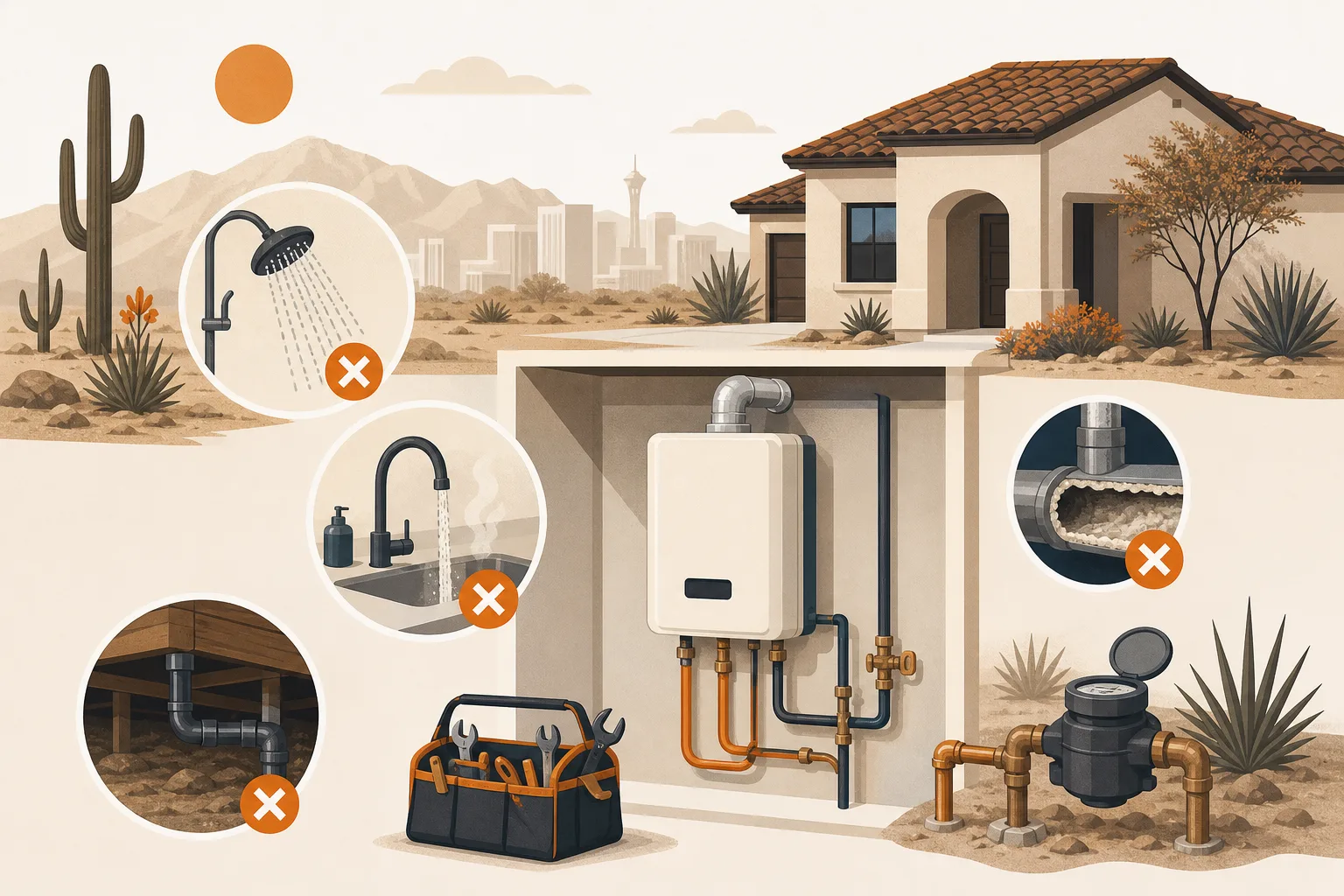
Tankless water heaters can be a great fit for Las Vegas homes, but only if they are sized, installed, and maintained for our extreme water and weather. Here are the most common mistakes we see and how to avoid them before you spend the money.
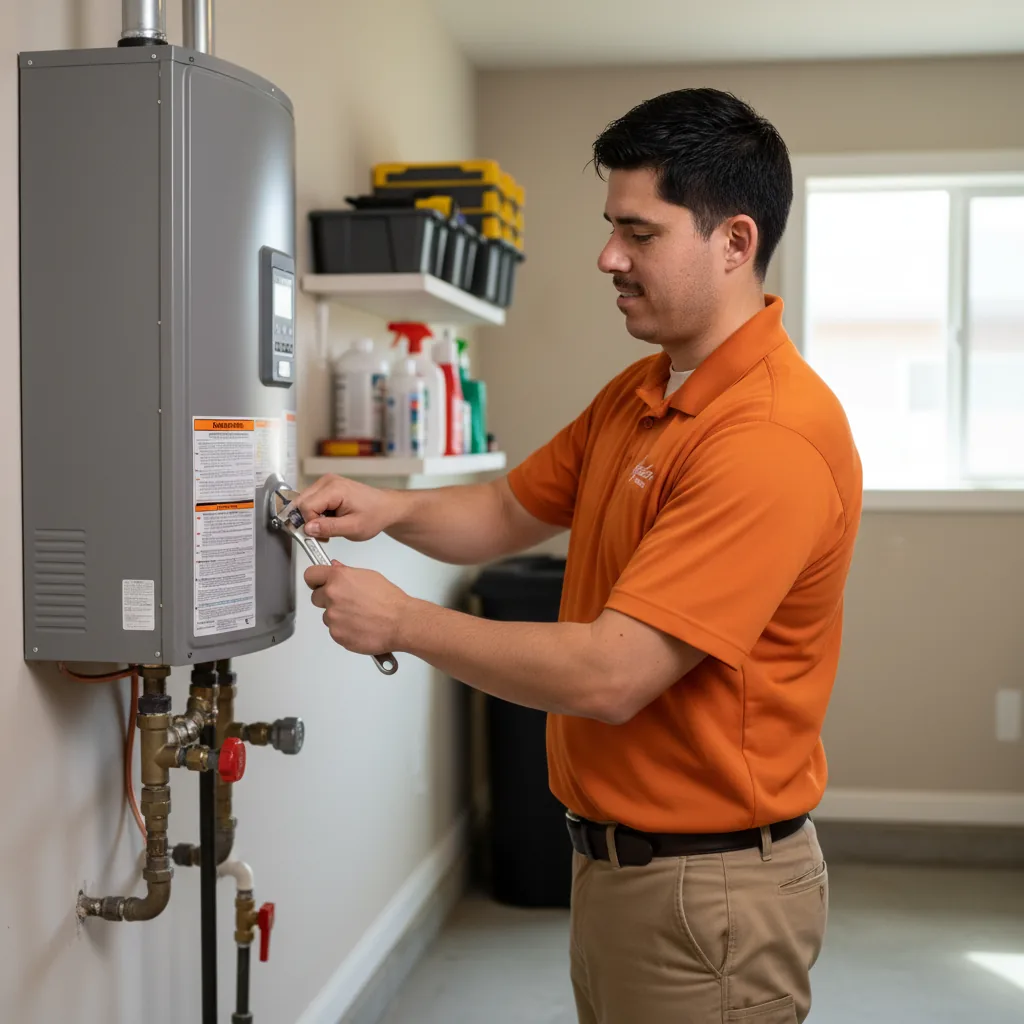
Why tankless water heaters are different in Las Vegas than in other cities
On paper, tankless water heaters look simple. A compact box that makes endless hot water and saves energy sounds like a no brainer. In the Las Vegas valley, the real story is a little more complicated because of our water quality, construction style, and local plumbing code. If you treat a tankless system like a plug and play swap for a tank, you can end up with a very expensive disappointment.
Per the Las Vegas Valley Water District, our water hardness is roughly 16 to 17 grains per gallon, or about 291 parts per million. That is classified as very hard water, which means minerals want to stick to anything hot inside your plumbing, especially a tankless heat exchanger. At the same time, most homes here are slab on grade with gas and water lines buried in walls and concrete, so mistakes with gas sizing, venting, or condensate routing are not easy to fix later. Clark County and the City of Las Vegas also adopted the 2024 Uniform Plumbing Code with Southern Nevada amendments, which add specific requirements for gas shutoffs, sediment traps, drain routing, and protection in garages and attics. All of that means a tankless water heater really has to be planned as a small project, not a quick hardware swap.
When tankless water heaters are sized and installed correctly, they can last 15 to 20 years or more, according to regional plumbing resources and national guidance. The U.S. Department of Energy notes that demand type heaters can outlast standard tanks and avoid standby losses, which can translate into energy savings in the range of about 8 to 34 percent depending on how much hot water your household uses. In Las Vegas, that longer life only shows up if your plumber designs for local realities like hard water, long hot runs across a single story slab, and extreme summer inlet temperatures that change system performance. Skipping those steps is where most homeowner mistakes start.
- Very hard water speeds up scale inside tankless heat exchangers.
- Slab on grade homes hide gas and water lines in walls and concrete.
- 2024 plumbing code updates add specific safety and drainage rules.
- Summer inlet temperatures and long runs change flow and performance.
Mistake 1: Ignoring Las Vegas hard water and scale on tankless units
The biggest local mistake with tankless water heaters is pretending our water behaves like soft or moderate water in other states. The Las Vegas Valley Water District reports hardness around 291 ppm, which is firmly in the very hard range. Those minerals are harmless to drink, but inside a tankless heater they slowly coat the tiny passages of the heat exchanger. Left alone, that buildup restricts water flow, makes the unit work hotter, and eventually triggers error codes or failure.
National guides often talk about flushing a tankless heater every few years. In this valley, that pace is usually too slow. Local plumbing resources recommend at least annual descaling in areas around 16 grains per gallon of hardness, and many homes that run a lot of hot water need service even more often. Homeowners sometimes think a water softener means they can skip maintenance, but softened water changes how scale forms rather than eliminating the issue entirely. The safest approach is to have a plumber who understands Las Vegas water test your conditions, set a descaling schedule, and install service valves that make that work straightforward. Skipping that step is one of the fastest ways to turn a long life tankless into a short life appliance.
- Very hard water coats tankless heat exchangers with mineral scale.
- Scale slowly reduces flow and makes the heater run hotter than designed.
- Annual professional descaling is usually needed in the Las Vegas valley.
- Water softeners help but do not replace regular tankless maintenance.
Mistake 2: Undersizing the tankless heater for your family and fixtures
Another common mistake is choosing a tankless model based on a simple bathroom count or a box label instead of real world demand. Tankless water heaters are limited by flow rate. They only have so much capacity to raise incoming water to your target temperature as it passes through. If the unit is too small for your peak use, you will notice hot water cutting out mid shower, lukewarm water when the dishwasher and washing machine run, or the heater shutting itself down with an error code.
National guidance from the U.S. Department of Energy explains that tankless energy savings depend heavily on how much and how often you use hot water. In Las Vegas, we add an extra twist. Inlet water from the Colorado River through Lake Mead can be much warmer in summer than in winter, which changes how much temperature rise the heater has to deliver. A good design for a tankless water heater in this valley looks at all your simultaneous loads, your desired shower and tap temperatures, and the seasonal swing in inlet temperature. A licensed plumber can run those numbers, walk your home to identify long runs and multi head showers, and sometimes recommend either a larger whole home unit or dedicated units for heavy use areas. Guessing from a chart at a big box store often ends with a unit that cannot keep up when the whole family wants to shower on a winter morning.
- Flow rate limits how many fixtures can run hot at the same time.
- Peak use is usually mornings and evenings when everyone needs hot water.
- Summer and winter inlet temperatures change how hard the heater must work.
- Professional sizing looks at fixtures, flow rates, and real use patterns.
Mistake 3: Overlooking gas line, venting, and code requirements in Clark County
Many homeowners focus only on the tankless unit itself and forget that it is part of a larger system. Tankless gas burners often require more fuel flow than the tank heater they replace, which can mean upsizing gas lines, adding or relocating shutoff valves, and installing a sediment trap under the 2024 Uniform Plumbing Code. If the existing gas piping is undersized or missing required features, the new unit can starve for gas or violate code, which affects safety and may cause problems if you ever sell the home or have an inspection.
Venting and drainage are just as important. Condensing tankless models need special vent pipe materials and specific routing for both exhaust and condensate. Local code requires an accessible gas shutoff ahead of the connector, proper support, and impact protection if the unit is in a garage. In attics or over living spaces, a drain pan with its own line is required and Southern Nevada amendments do not allow the pressure relief valve to discharge into that pan. That relief line must have its own route to the exterior. These are not details a homeowner should have to memorize, but they are exactly the kinds of things that separate a quick swap from a fully compliant, long term installation. A licensed, bonded, and insured plumber who works in Clark County every day will fold these code items into the design and quote so there are no surprises later.
- Tankless burners may need larger gas lines than your old tank heater.
- The 2024 Uniform Plumbing Code requires a sediment trap on gas lines.
- Garage and attic installs must include drainage and impact protection.
- Relief valve drains must run outside, not into a pan, under local amendments.
Mistake 4: Assuming energy savings and rebates appear automatically
Many people hear that tankless water heaters save energy and simply expect their gas bill to drop without any other changes. The U.S. Department of Energy notes that demand type heaters can reduce energy use by roughly 24 to 34 percent for homes that use less hot water and around 8 to 14 percent for homes with heavier usage. Those are national ranges and they depend on having the right size equipment, properly set temperatures, and efficient hot water habits. A tankless unit that is constantly fighting scale, running at maximum fire because of undersizing, or installed with long, uninsulated runs to distant bathrooms will not deliver those savings.
Financial incentives also have requirements. Southwest Gas, for example, offers a rebate in Nevada for installing an ENERGY STAR qualified natural gas tankless water heater with a high efficiency rating. To qualify, the unit must meet specific Uniform Energy Factor criteria, and the paperwork must be completed correctly. A licensed plumber who installs these systems regularly can recommend models that meet the rebate standard, set realistic expectations about energy savings in a Las Vegas slab home, and help you capture available incentives. The mistake is assuming that any tankless box on the wall will cut your bill dramatically and automatically qualify for every program.
- Energy savings depend on your actual hot water use pattern.
- Undersized or scaled up units may use more gas than expected.
- Rebates usually require specific efficiency ratings and paperwork.
- Professional design helps match your home to qualifying equipment.
Mistake 5: Treating tankless water heaters as zero maintenance appliances
The last big mistake is treating a tankless water heater as something you can forget about for a decade. While tankless units often last 15 to 20 years or more according to national and regional plumbing guidance, that longer life assumes regular maintenance. In Las Vegas, that maintenance is even more critical because of mineral content in Colorado River water and because our homes are mostly slab on grade. You do not get the early warning of a rusty basement tank. Problems can stay hidden until you have a full failure and a cold house.
A healthy maintenance plan for a tankless water heater in this valley usually includes annual descaling, filter checks, and a review of combustion air, venting, and condensate drains. A professional will also verify that the relief valve operates correctly and that the drain lines are still clear to the exterior under the local 2024 code. Kingdom Plumbing, for example, often pairs this visit with a quick visual check of other key plumbing items so that small issues are caught early. The key is to treat your tankless heater like the gas appliance it is, not like a sealed black box. Building a maintenance schedule into your calendar keeps energy savings on track and stretches the unit closer to that 15 to 20 year potential.
- Tankless heaters need regular descaling in very hard water.
- Annual checkups catch venting, gas, and drainage issues early.
- Relief valves and drain lines must be tested under local code.
- A maintenance plan helps your unit reach its full service life.
- Write down when and how your household uses hot water, including how many showers, loads of laundry, and dishwasher cycles happen at busy times, so your plumber can size the tankless unit accurately.
- Have a licensed plumber check your existing gas line size, meter capacity, and venting paths to see what upgrades, if any, are needed for a safe, code compliant tankless installation.
- Ask your plumber to factor Las Vegas water hardness into the design by including isolation valves and drain ports that make annual descaling fast and clean.
- Discuss whether a whole home tankless heater, multiple smaller units, or a hybrid layout best matches your floor plan and long pipe runs across a slab on grade house.
- Confirm that any tankless model you are considering meets current efficiency standards and ask your plumber which units qualify for available Southwest Gas rebates.
- Talk through where the tankless unit will physically sit, how the condensate and relief valve drains will reach the exterior, and what the 2024 Uniform Plumbing Code requires in that location.
- Plan a regular maintenance schedule, at least once a year, and put it on your calendar so descaling, safety checks, and code related inspections do not fall through the cracks.
- Request an upfront, flat rate quote that clearly separates the cost of the tankless heater, any gas or venting modifications, and necessary code upgrades so you understand exactly what you are buying.
Frequently asked questions
- Are tankless water heaters a good idea for Las Vegas homes with very hard water?
- They can be an excellent choice here, but only if you plan for our water hardness from the start. The Las Vegas Valley Water District measures local hardness around 16 to 17 grains per gallon, which means a tankless system needs built in service valves and regular descaling. With proper scale control and code compliant installation, many Las Vegas homeowners see long service life and consistent hot water from tankless systems.
- How often should a tankless water heater be flushed in Las Vegas?
- In areas with very hard water like Las Vegas, annual descaling is usually the minimum recommended schedule. Regional guides that serve communities with similar hardness advise at least a yearly flush to protect the heat exchanger from mineral buildup. Homes with large families or heavy hot water use may benefit from more frequent maintenance, which a local plumber can tailor based on your conditions.
- Will a tankless water heater really save me money on my gas bill?
- The U.S. Department of Energy reports that tankless water heaters can cut energy use by roughly 8 to 34 percent compared to standard tanks, depending on hot water demand. In real Las Vegas homes, savings depend on correct sizing, smart temperature settings, insulated hot water runs, and steady maintenance to keep scale under control. A poorly sized or neglected tankless unit may not deliver the savings you expect.
- Do I need a permit to install a tankless water heater in Clark County?
- Tankless water heater installations typically require permits because they involve gas, venting, and sometimes electrical and drainage changes. Clark County and local cities follow the 2024 Uniform Plumbing Code with Southern Nevada amendments, which includes requirements for gas shutoffs, sediment traps, and drain routing. A licensed plumber will usually handle the permitting and inspections for you and ensure the installation passes local code.
- Can a tankless water heater run multiple showers at once in my Las Vegas house?
- Yes, but only if the unit is sized for your peak simultaneous demand and local conditions. A proper design looks at how many gallons per minute your showers and fixtures use, the temperature rise needed from our Colorado River supply, and the layout of your plumbing. For bigger homes or heavy use, a plumber may recommend a higher capacity unit or multiple tankless heaters so you are not fighting over hot water.
- What is the main difference in lifespan between a tank and a tankless water heater here?
- Nationally, standard tank water heaters are often described as lasting about 8 to 12 years, but in the Las Vegas valley Kingdom Plumbing commonly sees tanks closer to 5 years because of hard water and local conditions. Tankless heaters, by contrast, are often rated for 15 to 20 years or more in national and regional guidance. In practice, reaching that longer life in Las Vegas depends on regular descaling, code compliant installation, and occasional professional checkups.
- Who should I call to get a quote for a tankless water heater in Las Vegas?
- For a tankless water heater that is sized and installed for Las Vegas water, code, and construction, it is smart to work with a local, licensed plumber that handles these systems every week. Kingdom Plumbing is a family owned company serving the Las Vegas valley since 2018, licensed, bonded, and insured under NV Contractors License number 0085422. We offer upfront flat rate pricing approved before work starts, and we back our tankless water heater service with a 100 percent satisfaction guarantee at (702) 840-5037.
Talk to Kingdom Plumbing about tankless water heaters, or call (702) 840-5037. Family-owned, NV Contractors License #0085422, upfront flat-rate pricing.
Kingdom Plumbing is a family-owned, licensed Las Vegas plumber (NV NV Contractors License #0085422) serving the valley since 2018. Questions about how this affects your home? Call (702) 840-5037. Dealing with a burst pipe or flooding right now? Our emergency plumbers in Las Vegas answer 24/7.