
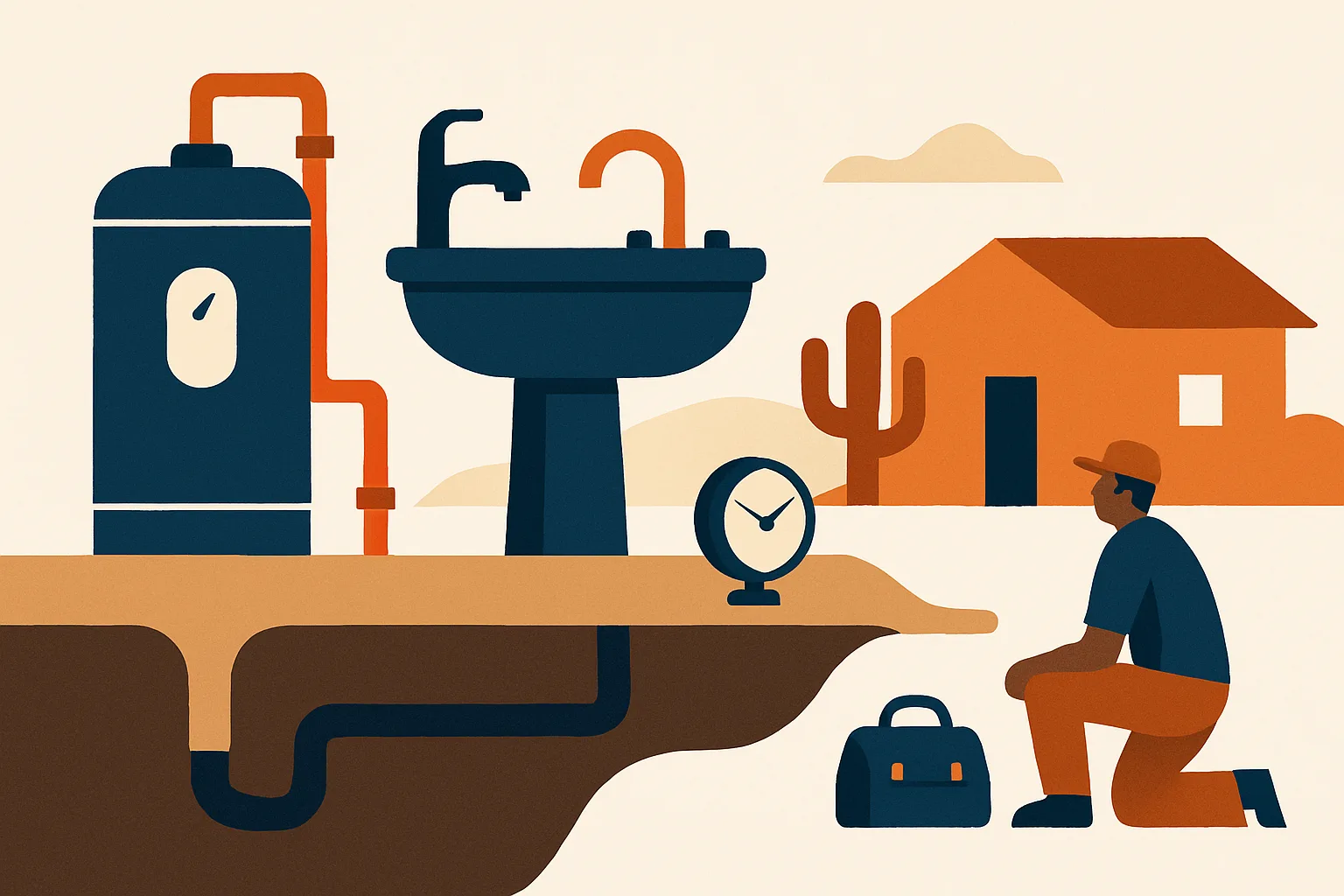
Commercial plumbing problems in Las Vegas are usually caused less by bad luck and more by a short list of avoidable mistakes. Knowing what property managers and owners overlook most can help you protect your building, budget, and tenants before you call a commercial plumber.
What makes commercial plumbing mistakes in Las Vegas so costly?
In commercial properties, plumbing is not just about comfort. It is tied directly to revenue, tenant satisfaction, health codes, and even insurance coverage. A small leak in a strip mall unit or restaurant can interrupt business, damage finishes, and trigger mold or water intrusion claims. Unlike a single-family home, there may be multiple restrooms, kitchens, tenant improvements, and shared mains on every floor that depend on the same system.
Commercial plumbing in Las Vegas also operates under tougher conditions than many owners realize. The Las Vegas Valley Water District reports that our municipal water hardness runs around 280 ppm, or about 16 grains per gallon, which is classified as very hard water. That level of mineral content speeds up scaling in water heaters, mixing valves, ice machines, and any high-use fixtures if they are not monitored and maintained. When that reality meets high foot traffic and longer operating hours, small oversights become expensive repairs much faster.
On top of that, labor and material costs for commercial plumbing are simply higher than for most residential jobs. Cost guides for the Las Vegas area show typical commercial plumbing projects starting around $1,200-$2,800 for smaller scopes and climbing to $5,000-$15,000 or more when large sections of piping, multiple fixtures, or major system upgrades are involved. Permit requirements, access challenges in occupied buildings, and coordinating around business hours all add complexity. The bottom line: avoiding a few common mistakes can keep you on the lower end of those ranges and reduce surprise downtime.
- Higher foot traffic stresses fixtures and drains
- Very hard water accelerates scale and wear
- More fixtures mean more potential leak points
- Permits and inspections add time and cost
Mistake 1: Treating commercial plumbing like a residential system
One of the biggest mistakes Las Vegas owners make is assuming commercial plumbing can be managed and priced like a home system. In a house, a slow drain or a single leaking toilet is often a nuisance. In a busy office, retail center, or short-term rental building, the same problem can affect dozens or hundreds of people in a single day. That difference changes how a professional should diagnose, stage, and repair every job.
Commercial work also requires deeper planning. According to trade rate guides, non-emergency licensed plumbers in Las Vegas typically charge in the $93-$165 per hour range, with higher rates for master-level or permit-heavy work. When you add more complex piping layouts, roof drains, grease lines, multiple restroom groups, and sometimes older or mixed materials, the time on site can increase quickly if the visit is not scoped properly. Treating it like a simple house call often leads to repeat visits, more disruption, and higher overall labor costs.
A commercial plumbing service should include a broader view of the entire system, not just the one fixture that is giving you trouble. That can mean tracing a recurring clog across multiple units, checking pressure across different floors, or inspecting common lines shared by several tenants. When owners only authorize the bare minimum, it may look cheaper that day, but they often end up paying more when unresolved issues resurface during peak business hours.
- Assuming one clogged toilet is an isolated problem
- Ignoring shared mains that serve multiple units
- Skipping system-wide pressure and flow checks
- Not budgeting enough time for a proper diagnostic
Mistake 2: Skipping scheduled maintenance in very hard Las Vegas water
Property managers and owners often expect commercial plumbing to run indefinitely until something breaks. In Las Vegas, this is a costly assumption. According to the Las Vegas Valley Water District, our water hardness is roughly 16 grains per gallon, which falls in the very hard category. Industry and property-management reports point out that neglecting scheduled maintenance in this kind of water leads to scale buildup, corrosion, and progressively slower drains that eventually require more invasive work.
In commercial properties, that hard water acts on everything: water heaters, mixing valves, flush valves, aerators, dish machines, and cooling equipment with plumbing connections. Without regular descaling, flushing, and inspection, mineral buildup narrows pipe and fixture openings, forces pumps and heaters to work harder, and shortens equipment life. Real estate management sources in Las Vegas highlight that they repeatedly see premature failure of fixtures and heaters where owners never implemented a routine maintenance plan.
A good commercial plumbing maintenance program is tailored to your specific building. High-use restrooms, restaurants with grease-producing kitchens, salons, and medical suites all place different demands on the system. A licensed commercial plumber can help you decide how often to perform tasks like water heater flushing, main line camera inspections, valve exercising, and fixture cleaning. While there is a cost to these visits, they are usually far below the price of emergency replacements and after-hours labor when something fails unexpectedly.
- Very hard water speeds up scale and clogging
- Lack of flushing shortens water heater life
- Ignored aerators and valves restrict flow
- Missed inspections hide early warning signs
Mistake 3: Using the wrong materials or mismatching existing systems
Another major mistake in commercial plumbing is mixing materials or sizes that are not compatible with the existing system. Industry articles on commercial failures note that mismatched metals, undersized or oversized lines, and incompatible fittings often become the first thing to fail. In older Las Vegas buildings that have seen multiple remodels, it is common to find a mix of copper, different generations of PEX, and sometimes galvanized steel tied together. If new work is added without a full understanding of how those materials interact, corrosion and leaks can show up much earlier than expected.
Commercial buildings also have stricter demands on flow rates and pressure balance than single-family homes. Swapping a fixture or section of pipe to save a little money, without matching the original design, can change the way whole sections of the building perform. For example, choosing the wrong carrier for a wall-hung commercial toilet, or using fittings that slightly reduce pipe diameter, may not be obvious immediately. Over time, it can contribute to chronic clogs, uneven flushing, and noisy plumbing that tenants complain about.
A licensed commercial plumber will evaluate not only the problem area, but also the adjacent branches, venting, and material types before recommending a fix. That often means suggesting a more complete replacement of a problematic run instead of tying new materials into a failing section. While it can increase the upfront invoice, it generally improves reliability and reduces the chance of reopening walls or ceilings a second time. The key for owners is to look at total lifecycle cost, not just the cheapest way to get water flowing today.
Mistake 4: Delaying repairs or choosing temporary fixes instead of real solutions
Property-management reports from Las Vegas consistently call out a pattern: small leaks or recurring clogs that are repeatedly “patched” rather than truly repaired. This short-term approach can be tempting when you have budget pressure, but it usually raises the final bill. Commercial plumbing cost guides show that larger-scope repairs and replacements in Las Vegas can run from $5,000 to $15,000 or more, in part because damage has spread by the time full work is finally approved.
Delays are especially risky in slab-on-grade construction that is common across the valley. A slow leak in a line under the floor can erode soil, create hidden moisture, and affect adjacent spaces long before it is visible. Choosing another quick snake for a line that backs up every few months, instead of investing in a camera inspection and targeted repair, can also hide broken or sagging sections that will eventually fail during business hours. As problems grow, so does the likelihood that a repair will require night or weekend work at higher hourly rates or even full closure of part of the building.
A better strategy is clear: if the same issue comes back more than once, treat it as a system problem instead of a one-off annoyance. Ask your commercial plumber for both a short-term and a long-term option, with pros, cons, and likely costs over the next few years. While the more complete solution may cost more initially, it often avoids emergency dispatch fees and multiple visits, and it gives you a more predictable maintenance budget to work with.
Mistake 5: Hiring on price alone instead of commercial expertise and planning
Because commercial plumbing can be a significant line item, many owners focus almost entirely on the lowest bid. Hourly labor benchmarks in Las Vegas show a wide range, from around $57 up to $185 per hour depending on role and complexity, and those numbers can catch your eye. The mistake is assuming that the lowest number on paper will translate to the lowest total cost or the least business disruption. An incomplete scope or an inexperienced commercial crew can easily stretch a 4-6 hour job into multiple days of partial closure.
The more important questions are about planning, communication, and experience with your type of property. A strong commercial plumbing service will ask about your tenant mix, peak business hours, any past issues, and access constraints long before tools come out. Good staging often allows work to be completed in off-hours or in phases, which may save you more in operational continuity than you spend on the plumber’s rate. Cost guides also show that larger commercial projects in Las Vegas frequently fall in the $5,000-$15,000 or higher bracket, so modest improvements in scope and scheduling can represent meaningful savings.
When comparing quotes, look for line-item clarity, permit handling, and a written plan for protecting finishes and coordinating with your occupants. Check that the company is licensed, bonded, and insured for commercial work in Nevada, and that they are comfortable explaining how they handle unexpected findings once walls or ceilings are opened. This kind of due diligence helps you avoid change-order surprises and gives you confidence that the work will stand up to inspections and tenant use.
How long does commercial plumbing work usually take in Las Vegas?
Time is often just as important as money when you are planning commercial plumbing projects. Cost and time guides for Las Vegas indicate that straightforward service calls and diagnostics are commonly in the 1-2 hour range, assuming access is simple and the problem is localized. Small fixture or leak repairs can sometimes be wrapped up in that same window, although ceiling access, crowded mechanical rooms, or working around customers may extend the visit.
More involved tasks such as commercial water heater replacement, multiple fixture changeouts, or sectional pipe replacement usually fall in the several-hour range. Industry guidance suggests that even residential water heater replacements can take 4-6 hours once you account for draining, hauling, reconnection, and testing, and commercial setups are typically more complex. Once you factor in pulling permits, scheduling inspections, and coordinating with building staff, multi-day timelines are common for larger projects.
When you meet with a commercial plumbing contractor, ask for both a work duration estimate and a disruption estimate. Those are not always the same thing. For instance, the crew might be on site for several days, but restrooms or kitchens could only be down for a portion of that time. Clear expectations and a written schedule let you notify tenants, post signage, and avoid surprises. Planning up front generally costs nothing and can prevent a lot of frustration for everyone involved.
- List every plumbing symptom you are seeing across the property, not just the one that triggered the call, so your commercial plumber can spot patterns that point to a system issue.
- Gather past invoices or notes from prior plumbing visits, which can help your plumber see if you have recurring problems in the same areas.
- Walk the building and talk with key tenants or staff to understand how plumbing issues are affecting operations and at what times of day impact is highest.
- Ask for a written scope of work that explains what areas will be inspected, what will be repaired or replaced, and how your walls, ceilings, and finishes will be protected.
- Request both a short-term repair option and a long-term solution, along with honest pros and cons, so you can choose what fits your budget and risk tolerance.
- Confirm that your contractor handles permits and inspections where required, and ask how they will communicate scheduling around your business hours.
- Discuss a regular commercial plumbing maintenance plan that accounts for Las Vegas’s very hard water and your specific building usage.
- Verify that the company is licensed, bonded, and insured in Nevada for commercial plumbing work, and that you will approve flat-rate pricing before work starts.
Frequently asked questions
- How much does commercial plumbing service cost in Las Vegas?
- Recent cost guides for Las Vegas indicate that many smaller commercial plumbing jobs fall in the $1,200-$2,800 range, while larger projects and system upgrades can run from about $5,000 to $15,000 or more. The final price depends on scope, accessibility, materials, permits, and whether the work is done during normal hours or as an emergency. Getting a detailed written scope from a licensed commercial plumber will give you a more accurate estimate for your particular building.
- Why is hard water such a big deal for commercial plumbing in Las Vegas?
- The Las Vegas Valley Water District reports our water hardness at around 280 ppm, which is about 16 grains per gallon and categorized as very hard. In commercial settings, that mineral content rapidly builds scale in water heaters, valves, aerators, and equipment that runs for long hours every day. Without regular flushing and maintenance, you can see reduced pressure, higher energy use, and earlier equipment replacement.
- How often should a commercial building have its plumbing inspected?
- There is no single schedule that fits every property, but property-management articles note that neglecting routine checks is one of the top causes of costly failures. High-use buildings such as restaurants, gyms, and medical offices often benefit from at least annual commercial plumbing inspections, with more frequent visits for known problem lines or grease systems. A licensed plumber can help you tailor a plan based on age, usage, and past issues.
- Can I use residential-grade fixtures in my commercial property to save money?
- Using fixtures or materials that are not intended for commercial duty is one of the mistakes industry guides highlight, because those components often fail first. Commercial spaces generally see much higher use and have different code and performance expectations than homes. Discuss fixture selection with a commercial plumbing professional so you balance upfront cost with durability, maintainability, and compliance.
- How long will a typical commercial plumbing repair keep my business closed?
- Many commercial service calls, such as clearing a localized clog or fixing a single leaking fixture, can be completed within 1-2 hours if access is straightforward. Larger work, such as water heater replacement or pipe section replacement, can take several hours or more and may require scheduling around your busiest times. A good commercial plumber will give you a clear plan that separates total job duration from the actual downtime for each restroom or area.
- What should I ask a plumber before hiring them for commercial work?
- Ask about their experience with your specific property type, how they plan to protect tenants and finishes, and whether they routinely handle permits and inspections. It is also smart to request a detailed scope, a projected timeline, and clarification on how unexpected findings will be priced and communicated. Confirm they are licensed, bonded, and insured in Nevada and that you will see flat-rate pricing for the agreed scope before any work starts.
- Is it worth paying more for a comprehensive fix instead of another quick patch?
- Reports from Las Vegas property managers show that repeated short-term fixes for the same issue often add up to more than a proper repair would have cost. Quick patches can be appropriate in some situations, but if you have recurring clogs or leaks, a more complete solution usually reduces downtime and emergency calls. Asking your commercial plumber for lifecycle cost comparisons can help you decide which option fits your long-term plans for the property.
Talk to Kingdom Plumbing about commercial plumbing, or call (702) 840-5037. Family-owned, NV Contractors License #0085422, upfront flat-rate pricing.
Kingdom Plumbing is a family-owned, licensed Las Vegas plumber (NV NV Contractors License #0085422) serving the valley since 2018. Questions about how this affects your home? Call (702) 840-5037. Dealing with a burst pipe or flooding right now? Our emergency plumbers in Las Vegas answer 24/7.