TL;DR: Las Vegas has some of the hardest water in the country, measuring 16–22 grains per gallon (GPG) according to the Southern Nevada Water Authority. That’s nearly double the USGS threshold for “very hard” water. About 90% of our water comes from Lake Mead via the Colorado River, which picks up calcium and magnesium as it flows through limestone rock. This guide breaks down exactly what those Las Vegas hard water numbers mean, how to test your own water, and what it’s doing to your home.
If you’ve ever wondered why your shower doors are always cloudy, your faucets have white crusty buildup, or your skin feels dry no matter what lotion you use, the answer is probably staring back at you every time you turn on the tap. Las Vegas hard water is one of the most common — and most overlooked — household issues in the valley.
But what does “hard water” actually mean? And how bad is it in Las Vegas compared to the rest of the country? Let’s look at the real numbers.
What Is Water Hardness?
Water hardness is a measurement of dissolved minerals in your water supply, primarily calcium and magnesium. These minerals are naturally occurring — they dissolve into the water as it flows through rock and soil underground.
Water hardness is measured two ways:
Grains per gallon (GPG) is the standard unit used by water treatment professionals. One grain per gallon equals approximately 17.1 milligrams per liter (mg/L) of calcium carbonate.
Parts per million (PPM) or milligrams per liter (mg/L) is the measurement used in laboratory water quality reports and government testing. PPM and mg/L are interchangeable for water hardness purposes.
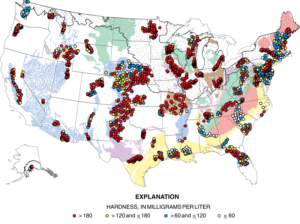
The U.S. Geological Survey (USGS) classifies water hardness on this scale:
- Soft: 0–60 mg/L (0–3.5 GPG)
- Moderately hard: 61–120 mg/L (3.5–7.0 GPG)
- Hard: 121–180 mg/L (7.0–10.5 GPG)
- Very hard: Greater than 180 mg/L (greater than 10.5 GPG)
Las Vegas hard water doesn’t just qualify as “very hard.” It blows past the threshold.
How Hard Is Las Vegas Tap Water?
This is the question every homeowner should be asking about Las Vegas hard water. The short answer: extremely hard.
SNWA Water Hardness Data
The Southern Nevada Water Authority (SNWA) manages and treats the water supply for approximately 2.2 million residents across the Las Vegas Valley. According to SNWA’s published water quality data, Las Vegas hard water typically measures between 16 and 22 GPG, or roughly 278 to 375 PPM.
To put that in context, the USGS threshold for “very hard” water is 180 PPM (10.5 GPG). Las Vegas water is 1.5 to 2 times above that threshold. That makes our tap water harder than what flows through most American homes.
The primary minerals driving that hardness are calcium and magnesium. These aren’t harmful to drink — the EPA does not regulate water hardness as a health concern, and SNWA water meets all federal Safe Drinking Water Act standards. The issue is what those minerals do to your plumbing system, appliances, and daily comfort over time.
How Las Vegas Compares to the National Average
The national average water hardness in the United States falls in the range of approximately 100–150 PPM (roughly 6–9 GPG), which the USGS classifies as “moderately hard” to “hard.”
Las Vegas water at 278–375 PPM is roughly two to three times higher than the national average. Cities in the Southwest and Great Plains tend to have harder water due to limestone and mineral-rich geology, but Las Vegas consistently ranks among the hardest municipal water supplies in the country.
For a general sense of how Las Vegas compares, here are approximate hardness ranges reported by municipal water utilities in other major cities (exact numbers vary by year and distribution zone — check your local utility for current data):
- Seattle, WA: approximately 20–30 PPM (soft)
- Portland, OR: approximately 10–20 PPM (soft)
- Phoenix, AZ: approximately 200–300 PPM (very hard)
- San Antonio, TX: approximately 200–350 PPM (very hard)
- Las Vegas, NV: approximately 278–375 PPM (very hard)
If you’ve moved to Las Vegas from the Pacific Northwest, the Midwest, or the East Coast, the difference in water hardness is dramatic — and you’ve probably already noticed the effects.
Where Does Las Vegas Water Come From?
Understanding where our water originates explains why Las Vegas hard water is so extreme.
Lake Mead and the Colorado River
Approximately 90% of the Las Vegas Valley’s water supply comes from Lake Mead, which is fed by the Colorado River. SNWA operates the intake and treatment infrastructure that pulls water from the lake and processes it for residential and commercial use.
The Colorado River flows over 1,400 miles from its headwaters in the Rocky Mountains of Colorado through Utah, Arizona, and Nevada before reaching Lake Mead. Along that journey, the water passes through massive formations of limestone, dolomite, and other mineral-rich sedimentary rock. As it flows, the water dissolves calcium carbonate and magnesium — the two minerals responsible for water hardness.
By the time it reaches Lake Mead and enters SNWA’s treatment facilities, the water has picked up a heavy mineral load. SNWA treats the water for safety (removing bacteria, viruses, and regulated contaminants), but standard municipal treatment does not remove hardness minerals. That’s by design — calcium and magnesium are not health hazards, so water utilities are not required to remove them.
Groundwater Sources
The remaining portion of the Las Vegas water supply comes from local groundwater wells. Groundwater in the Las Vegas Valley also tends to be hard because it sits in and flows through the same mineral-rich geology. In some areas, groundwater hardness can actually be higher than surface water from Lake Mead, depending on the depth and location of the well.
The Las Vegas Valley Water District (LVVWD), which distributes water to most of the valley, blends surface water from Lake Mead with local groundwater. This means water hardness can vary slightly depending on your specific neighborhood and what mix of sources is feeding your area.
How to Test Your Water Hardness at Home
You don’t have to take our word for it. There are several ways to confirm Las Vegas hard water levels at your own tap.
DIY Test Strips
Water hardness test strips are available at most hardware stores, home improvement centers, and online retailers for about $8–$15 per kit. They’re simple to use:
- Fill a glass with cold tap water directly from the faucet
- Dip the test strip into the water for the time indicated on the packaging (usually 1–3 seconds)
- Remove the strip and compare the color change to the chart provided
Test strips give you a general range in PPM or GPG. They’re not laboratory-precise, but they’ll confirm what most Las Vegas homeowners already suspect: your water is very hard.

Professional Water Testing
For a more accurate measurement, you can:
- Request a free water quality report from SNWA. SNWA publishes an annual Consumer Confidence Report (also called a Water Quality Report) that includes hardness data for the Las Vegas Valley. You can access it on their website at snwa.com.
- Schedule a professional water test. At Kingdom Plumbing, we offer water hardness testing as part of our water softener consultations. We test the water at your specific tap to give you an exact GPG reading for your home — not just a valley-wide average.
A professional test is especially useful if you want to know the exact hardness level at your faucet, which can vary based on your home’s location within the distribution system.
What Hard Water Does to Your Home Over Time
Knowing your water is hard is one thing. Understanding what Las Vegas hard water actually does to your home over time is what motivates most homeowners to take action.
Scale Buildup in Pipes and Fixtures
Calcium and magnesium in hard water form a solid deposit called “scale” or “limescale” as water evaporates or is heated. You can see this as the white, chalky buildup around faucets, on showerheads, and on glass shower doors.
What you can’t see is worse. That same scale is forming inside your pipes. Over months and years, the buildup narrows the interior diameter of your plumbing, restricting water flow and reducing water pressure throughout your home. Copper pipes — common in Las Vegas homes built from the 1980s through the 2000s — are particularly susceptible to hard water corrosion and scale accumulation.
Impact on Water Heaters and Appliances
Your water heater takes the hardest hit. When hard water is heated, minerals precipitate out of the water faster and form a thick sediment layer at the bottom of the tank. According to the U.S. Department of Energy, this scale buildup can reduce water heater efficiency by up to 29%, meaning higher utility bills every month.
Hard water also shortens the lifespan of water heaters by an estimated 2–4 years. Dishwashers, washing machines, and ice makers face similar issues — mineral deposits clog internal components, reduce cleaning effectiveness, and lead to earlier failure.
Effects on Skin and Hair
Hard water reacts with soap to form a sticky residue instead of a clean lather. This residue clings to your skin and hair, leading to:
- Dry, irritated, or itchy skin
- Dull, brittle hair that’s difficult to manage
- Soap and shampoo that won’t rinse away completely
- Worsened eczema and skin sensitivity
Many Las Vegas residents who install water softeners report noticeable improvements in their skin and hair within the first week.
How to Fix Hard Water in Las Vegas
The most effective and permanent solution for Las Vegas hard water is a whole house water softener. These systems use ion exchange technology to remove calcium and magnesium from your water before it reaches your pipes, water heater, and faucets.
A properly sized water softener for a Las Vegas home needs to handle the high mineral load our water carries. Systems rated for 40,000–50,000 grain capacity are typical for a family of four in our area, though the exact size depends on your household water usage and peak demand.
If you’re considering a water softener, we’ve written a comprehensive guide covering everything from system types to installation and maintenance: Water Softener Las Vegas: Why Every Valley Home Needs One.
Want to know exactly how hard your water is? Contact Kingdom Plumbing for a free water hardness test at your home. We’ll measure your water, explain your options, and provide a no-obligation quote for installation.
Frequently Asked Questions
Why Kingdom Plumbing for Las Vegas Hard Water Solutions
Kingdom Plumbing has been helping Las Vegas homeowners deal with hard water for years. We understand the specific challenges our valley’s water creates because we work with it every single day. Whether you need a water hardness test, a water softener installation, or maintenance on an existing system, we’re the local team that knows Las Vegas water inside and out.
Ready to stop hard water damage? Call Kingdom Plumbing today for a free water hardness test and consultation.